
From Strategy to Execution: Angeline Ong’s Journey Through the NUS Business School’s Chief Strategy Officer Programme
- How the NUS Business School’s CSO Programme Enhanced Her Strategic Mindset
- Innovative Leadership Through Role Swapping
- Practical Skills and Tools Acquired
- Personal Growth and Transformation After the NUS Business School’s CSO Programme
- Advice for Future Participants
- Conclusion: From Learner to Leader
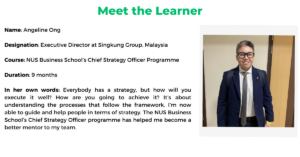
For Angeline Ong, a senior executive from Malaysia with extensive experience in managing warehouse and logistics operations, the decision to upskill and join the NUS Business School’s Chief Strategy Officer (CSO) Programme was driven by a desire to evolve her strategic thinking and improve her approach to leadership.
“I have to be honest,” Ong admits. “The main point was for networking and cross-sharing of knowledge with my peers.” For Angeline, the opportunity to learn directly from experienced professionals and industry experts was a powerful motivator. The chance to engage in real-world discussions and hear first-hand experiences from other leaders was an opportunity she could not pass up.
Her goal was clear: to learn how to implement strategy more effectively within her organisation and sharpen her ability to lead with greater impact.
How the NUS Business School’s CSO Programme Enhanced Her Strategic Mindset
The core learning from the CSO programme, according to Angeline, was a fresh perspective on what strategy truly means. She points out that while many people see strategy as a simple framework, it’s much more complex.
“Everybody has a strategy, but how will you execute it well? How are you going to achieve it? It’s about understanding the processes that follow the framework,” she explains.
For Angeline, this meant going beyond theory to explore how strategy could be applied and executed effectively within her organisation. By adopting a process-driven approach to strategy, she was able to link abstract concepts to tangible outcomes. This transformation in her thinking gave her the clarity and confidence to tackle more ambitious goals in her role.



Innovative Leadership Through Role Swapping
One of the most impactful lessons Angeline learned from the CSO programme was the importance of rethinking authority and roles within a team. Drawing inspiration from discussions with her professors, she decided to put this idea into practice by swapping the roles of team members within her management team.
“I swapped the positions of team members in my management,” she shares. “If the authority goes to a different position, people will see different approaches, and we’ll get different results.”
This strategic move had a profound impact on how her team approached projects. By reassigning key roles, she allowed team members to experience each other’s challenges and perspectives. This approach led to stronger collaboration, innovative problem-solving, and faster project execution. Angeline’s experiment highlighted how important it is for leaders to challenge traditional power structures and encourage cross-functional thinking.
The experience was a testament to the fact that true leadership is about empowering others. By allowing her team to see situations from a fresh perspective, she was able to unlock new levels of productivity and innovation.
Practical Skills and Tools Acquired
The NUS Business School’s CSO programme is known for its balance of theoretical insight and practical application, and Angeline, this blend was a game-changer. Among the most useful skills she developed were:
Mastering the PESTEL and SWOT Frameworks
“Our professor said, ‘What if we swapped roles and looked at the PESTLE analysis from a different perspective?’” Ong recalls. This shift in approach challenged her to examine strategic frameworks from new angles, which enabled her to approach business analysis with greater creativity and critical thinking.
Critical Thinking in Strategy Execution
As she points out, having a strategy isn’t enough—executing it well is the real challenge. Through the programme, she learned to break down large objectives into manageable, measurable processes, which ensured that goals could be achieved more efficiently.
Framework-Driven Approach to Strategy
The programme’s focus on frameworks and models gave Ong a strong foundation to assess strategic challenges. By leveraging tools like the SWOT Analysis and PESTEL Analysis, she was better prepared to tackle uncertainties in her business environment.
Personal Growth and Transformation After the NUS Business School’s CSO Programme
 Beyond technical skills, Angeline’s personal growth throughout the programme was equally noteworthy. As a senior executive, she was already familiar with the pressures of leadership, but her time in the CSO programme challenged her to think more deeply about her leadership style.
“I’m now able to guide and help people in terms of strategy,” she shares. “This programme helped me become a better mentor to my team.”
Angeline’s approach to mentorship and leadership has shifted as a result of the course. By swapping roles within her team, she allowed her colleagues to experience decision-making from new perspectives. This shift in her leadership approach enabled her to create a more dynamic, flexible, and responsive team environment.
Her experience also reflects the broader impact of the CSO programme—helping senior leaders develop the confidence and clarity to lead their organisations through change and uncertainty.
Advice for Future Participants
When asked to share advice for future participants of the NUS CSO programme, Ong didn’t hesitate. Her key message was clear:
“Go into full detail and don’t skip the networking part,” she advises. “When you’re with your peers, talk to them and share experiences. It’s not like reading from a history book—this is real life, and you’re getting live feedback.”
For Angeline, the peer learning experience was one of the most rewarding aspects of the programme. Being able to connect with other senior executives gave her access to new ideas, fresh perspectives, and invaluable support.
Conclusion: From Learner to Leader
Angeline Ong’s journey through the NUS Business School’s Chief Strategy Officer (CSO) Programme exemplifies how senior executives can use structured learning to sharpen their strategic leadership skills. From mastering frameworks like PESTEL to embracing bold leadership experiments like role-swapping, her story illustrates the transformative power of continuous learning.
Her experience demonstrates how the CSO programme not only equips participants with the tools to think strategically but also instils the confidence to lead with impact. By embracing the programme’s blend of networking, peer learning, and strategic development, Ong emerged with a stronger understanding of how to align strategy with execution.
If you’re a business leader seeking to take your career to the next level, the NUS Business School’s Chief Strategy Officer (CSO) Programme may be the game-changer you’re looking for. Just as it did for Angeline, this programme has the potential to transform how you lead, execute, and inspire others to achieve strategic success.