
Balance AI Governance and Global Regulations With Cambridge AI Training for Leaders
| Synopsis:
AI is reshaping business, but regulation is catching up fast. This blog explores how the Cambridge AI Leadership Programme provides strategic AI training to help executives lead responsibly, aligning governance with innovation. |
Artificial intelligence (AI) is reshaping every facet of business. From predictive analytics in customer service to automation in supply chains, AI’s influence is undeniable. Yet as AI adoption accelerates, regulatory scrutiny intensifies. The question facing executives today is not just how to leverage AI for innovation but how to manage AI responsibly within a tightening global legal framework.
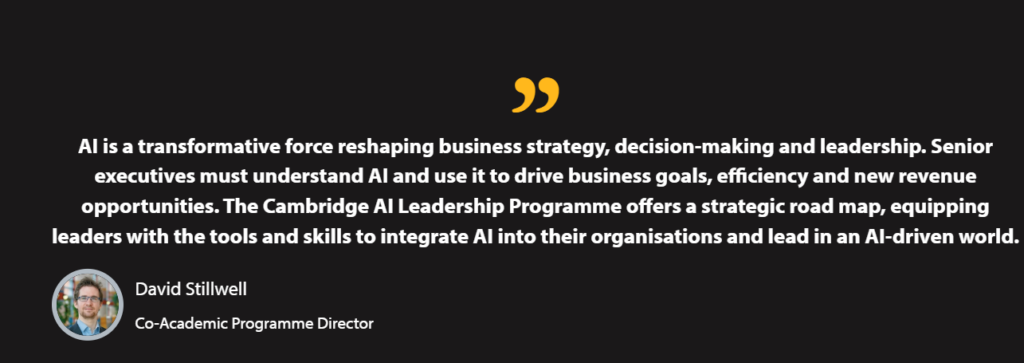
The answer begins with AI training that goes beyond technical upskilling. The Cambridge AI Leadership Programme—offered by Cambridge Judge Business School Executive Education—equips senior leaders with the tools to lead AI innovation responsibly. This AI training for executive leaders combines strategic thinking with global regulatory insight to help executives create resilient, ethical, and forward-looking AI strategies.


Turning Compliance Into Competitive Advantage With Cambridge AI Training
Leading with responsible AI doesn’t mean slowing down innovation. On the contrary, a well-structured governance model builds trust, supports sustainable AI, and opens new markets. Keeping this in mind, the Cambridge AI Leadership Programme helps leaders reframe regulation as a catalyst for trust and growth. Through a blend of live and self-paced learning, the program explores the intersection of data science, ethics, and global policy. Participants engage with real-world case studies, applying insights from leading experts to their unique industry contexts.
By aligning AI development with legal and ethical standards, leaders can:
- Strengthen brand credibility.
- Build stakeholder confidence.
- Unlock new markets that prioritize responsible innovation.
This AI training is designed to foster enterprise-wide agility, ensuring AI strategy evolves in lockstep with emerging laws and technologies.
Cambridge AI Training: Embedding Responsible AI at the Core
Leading organizations driven by AI responsibly requires embedding ethics at every stage of the AI life cycle. From defining data collection protocols to evaluating model outcomes, responsible AI starts with asking the right questions:
- Does this machine learning algorithm reinforce bias?
- Are we ensuring that AI systems are fair, transparent, and accountable?
- Is our data quality high enough to produce reliable outcomes?
The Cambridge AI training course for executive leaders emphasizes ethical risk mapping and cross-functional governance models. Executives learn how to establish oversight committees, assess AI applications against societal impact, and integrate data protection protocols across teams.
Data Integrity and Model Transparency
Effective AI training courses must tackle a foundational element of responsible AI: data integrity. Inaccurate or biased data can distort models, leading to flawed outcomes and regulatory violations. Leaders must ensure robust data quality and have mechanisms to audit and intervene when anomalies arise.
This includes:
- Assessing training datasets for representativeness
- Implementing protocols to detect drift in generative AI models
- Enabling explainability for all deployed AI tools
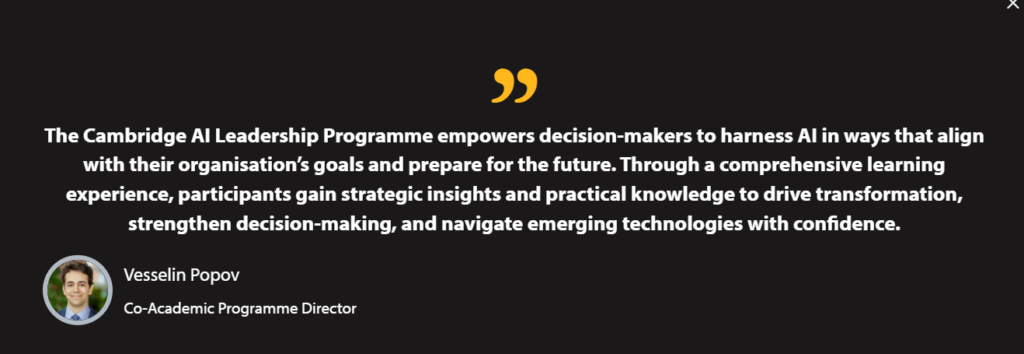
Cambridge AI training familiarizes senior executives with the right tools to mitigate risk and enhance performance and trust in AI systems.
Driving Effective AI Initiatives
As AI becomes integral to business strategy, the C-suite must evolve. Roles such as the chief AI officer or chief data and ethics officer are emerging, emphasizing the need for leadership equipped with regulatory insight and technical fluency.
Through the Cambridge AI training program, executive leaders explore:
- The global impact of artificial intelligence (AI) policy
- Navigating ethical debates around public service AI
- Communicating AI strategy to boards, regulators, and stakeholders
Topics in the program range from software development aligned with compliance to forecasting the impact of AI on industry ecosystems. Such training bridges the gap between innovation and governance, empowering leaders to champion sustainable AI transformation.
Lead With Confidence
Artificial intelligence (AI) presents both enormous promise and real risk. This world of emerging technologies demands comprehensive AI leadership combining strategic foresight, ethical clarity, and actionable frameworks. Forward-thinking business leaders must take ownership of AI governance, build AI strategies that can adapt to change, and align innovation with compliance.
Download the Cambridge AI Leadership Programme brochure and learn how this course will help you turn regulatory complexity into strategic opportunity.