
Imperial Nutrition for Health Course: Insights from Dr. Federica Amati
- A Crisis of Misinformation and Missed Opportunity
- The Evidence-Based Approach at Imperial College London
- Who is Dr. Federica Amati?
- Transformative Learning With Real-World Relevance
- Why Nutritional Awareness Matters to Executive Leaders
- The Imperial College Advantage
- Changing Perspectives: Nutrition as a Strategy
Synopsis:Dr. Federica Amati, medical scientist and nutritionist at Imperial College London, explains why evidence-based nutrition is vital in today’s healthcare. Backed by Imperial College Business School, this blog explores how nutrition strategies can transform lives and how Dr. Amati addresses this in the Nutrition for Health course. |
Modern healthcare systems worldwide are under pressure to respond to rising rates of chronic illness, escalating healthcare costs, and an aging population. Yet, despite vast technological advancements, one essential element continues to be overlooked in preventive and public health strategies: nutrition.
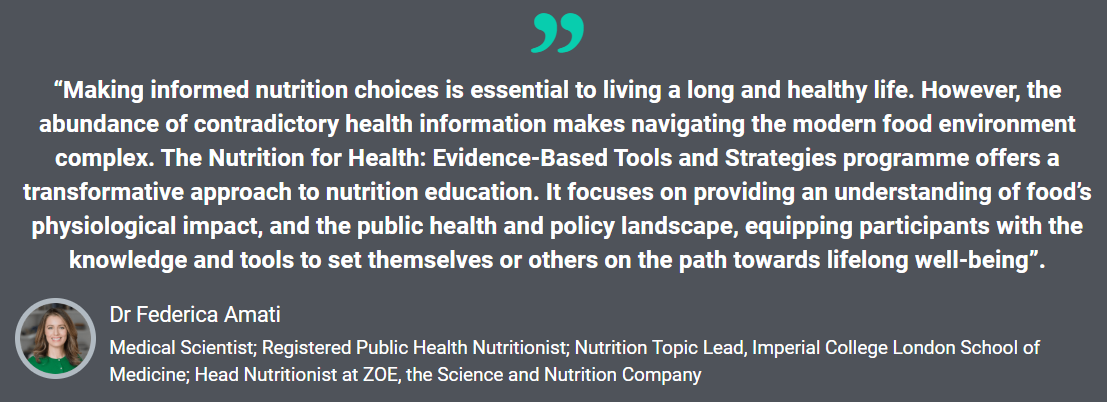
Dr. Federica Amati, a leading voice in evidence-based nutrition science and Imperial College faculty member, is on a mission to reposition food as a central lever for health transformation. Backed by Imperial College London School of Medicine, her work in the Nutrition for Health: Evidence-Based Tools and Strategies course highlights why nutrition is not only a personal lifestyle choice—it is a critical healthcare imperative.


A Crisis of Misinformation and Missed Opportunity
Global dietary trends present a troubling reality. According to Imperial College Business School, only 33% of UK adults meet the five-a-day guideline for fruit and vegetable intake. At the same time, one in eight people worldwide are living with obesity.1 These figures expose the deep disconnect between available nutritional knowledge and real-world application.
Federica Amati, a medical scientist and registered public health nutritionist, has emerged as a reliable source of truth amid widespread dietary misinformation. Through the six-week online program titled Nutrition for Health: Evidence-Based Tools and Strategies, offered by Imperial College Business School, she equips healthcare professionals and health-conscious leaders with science-backed tools to close the knowledge-implementation gap.
The Evidence-Based Approach at Imperial College London
Anchored in Imperial College London School of Medicine, one of the constituent colleges of Imperial, the course led by Dr. Federica Amati draws on decades of cross-disciplinary research from the Faculty of Medicine, Faculty of Natural Sciences, and Imperial College Business School. The curriculum integrates insights from prestigious erstwhile institutions such as the Royal College of Science, Royal College of Chemistry, City and Guilds of London Institute, St Mary’s Hospital Medical School, and Charing Cross and Westminster Medical School—which were all later merged to form the Imperial College of Science and Technology and later the Imperial College School of Medicine.
Who is Dr. Federica Amati?
As the faculty head of the Nutrition for Health: Evidence-Based Tools and Strategies program, Dr. Federica Amati brings a wealth of academic and applied experience. She holds a doctorate in Medical Science from Imperial College London, a Master’s in Public Health, and an MSc in Nutrition from the London School of Hygiene and Tropical Medicine.
Beyond academia, Dr. Federica Amati serves as the Head Nutritionist at ZOE and Head of Nutrition Science at Wellfounded Health. Her research spans the gut microbiome, metabolic health, and the role of nutrition in disease prevention and healthy aging. She is the author of “Recipes for a Better Menopause” and “Every Body Should Know This,” both of which reinforce her mission to make evidence-based nutrition accessible.
Her approach is firmly grounded in rigorous scientific inquiry—evident in her emphasis on tools such as the ABCDE framework for assessing nutritional health and the evidence pyramid to distinguish between opinion and verified research.
Transformative Learning With Real-World Relevance
Unlike generic health courses, this program is built to deliver applied learning for modern professionals. Participants analyze global food systems, investigate ultra-processed foods, assess gut health, and decode food marketing and labeling.
Executive learners are encouraged to critically evaluate dietary patterns such as the Mediterranean and DASH diets, understand the role of gut microbiota, and develop actionable strategies for both personal and client-facing use. The program also dives into health equity, examining social determinants of food choices and the interconnectedness of nutrition and planetary health.
Notably, the course also includes a verified digital certificate from Imperial College London, adding credibility to its academic rigor.
Why Nutritional Awareness Matters to Executive Leaders
As C-suite leaders grapple with employee wellness, healthcare costs, and ESG commitments, nutrition education emerges as a high-leverage intervention. Whether leading a healthcare organization, developing wellness-focused startups, or managing employee benefit programs, understanding nutrition through a clinical and systemic lens can enable executives to make more informed strategic decisions.
The executive nutrition program from Imperial is not only for medical professionals. It is equally suited for entrepreneurs, business-oriented learners, and wellness advocates looking to apply cutting-edge research in order to build solutions grounded in science.
The Imperial College Advantage
Ranked #1 in Europe by the QS World University Rankings – 2025,2 and top-ranked by sources such as The Guardian and US News, Imperial College offers more than prestige. It represents a hub for rigorous science, policy influence, and real-world impact.
From its prestigious position near Prince Albert’s legacy institutions to its data-driven, actionable curriculum, Imperial Business School is redefining what executive education in health looks like.
Changing Perspectives: Nutrition as a Strategy
In the age of precision medicine, global health crises, and employee burnout, nutrition can no longer remain a footnote. As Federica Amati and her colleagues at Imperial College demonstrate, empowering leaders with evidence-based tools is the first step toward a healthier society.
To explore how you can integrate this critical perspective into your leadership journey, discover the Nutrition for Health: Evidence-Based Tools and Strategies program at Imperial College Business School.