
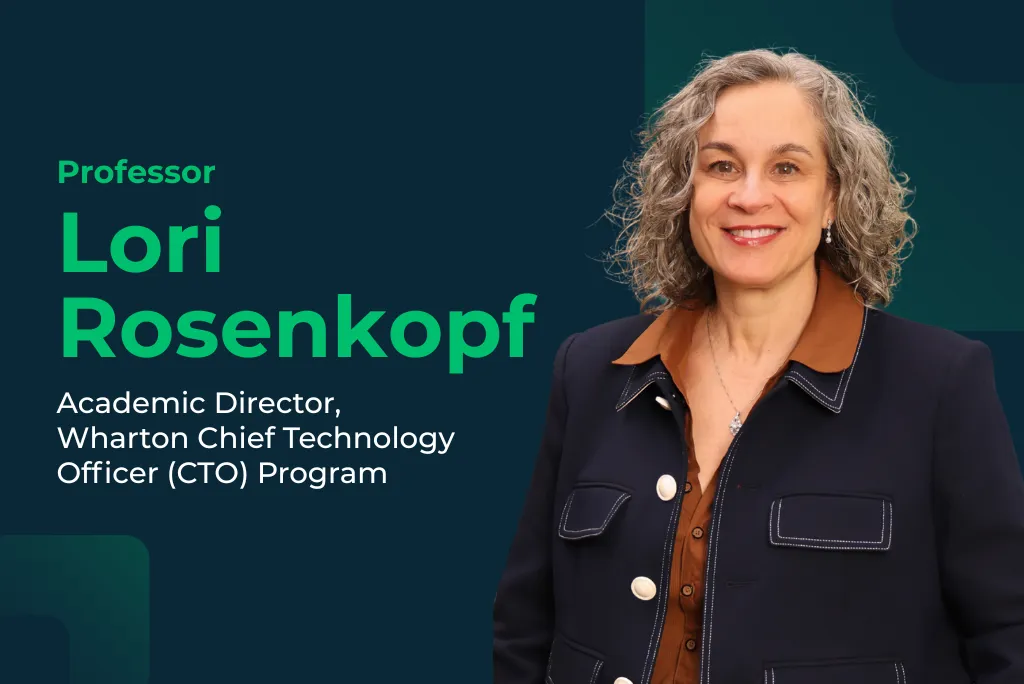
Professor Lori Rosenkopf on How the Wharton CTO Program Prepares Future-Ready Tech Leaders
| Summary:
Read Wharton CTO Program Academic Director Lori Rosenkopf’s insights on how the program prepares senior technology leaders to navigate complex business challenges and drive innovation in today’s technology-driven landscape. |
Leadership today requires more than technical know-how. It demands the ability to anticipate change, drive innovation, and influence across the C-suite. The Wharton Chief Technology Officer (CTO) Program is crafted to prepare senior technology leaders for exactly this challenge.
“As technology now permeates every aspect of business, we empower individuals with deep expertise to integrate recent advancements, especially in AI, into all facets of an organization.”
—Professor Lori Rosenkopf, Academic Director, Wharton CTO Program
In this interview Professor Rosenkopf shares her insights on how the Wharton Executive Education CTO Program equips leaders to drive transformative change from the C-suite and beyond.


In Conversation With Professor Lori Rosenkopf
Q: What makes the Wharton CTO Program unique for senior tech leaders?
Prof. Lori Rosenkopf: One of the most important parts of the Wharton CTO Program is that it brings together a diverse cohort of learners from various industry sectors and companies, enabling them to learn from both professors and each other’s experiences. In addition, we provide learners with exposure to state-of-the-art knowledge through 10 different faculty members in our core curriculum and a variety of electives.
Q: How is the Wharton CTO Program curriculum structured to address executive challenges?
Prof. Lori Rosenkopf: The core curriculum of the Wharton CTO Program is organized into three parts:
- Strategizing
- Scanning
- Implementing
In each part, learners reflect on the different frameworks, theories, and examples that professors teach, as well as what they hear from their classmates, and apply that knowledge to a real-world challenge they are currently facing.
Discover how past learners transformed their leadership and tech expertise—read their firsthand experiences in our Wharton CTO Program reviews.
Q: How does the Wharton CTO Program shape the future of leadership?
Prof. Lori Rosenkopf: The Wharton CTO Program is vital for developing the next generation of leaders. It prepares them to lead not just in the technology sector, but across the entire C-suite. As technology now permeates every aspect of business, we empower individuals with deep expertise to integrate recent advancements, especially in AI, into all facets of an organization, including:
- Product creation
- Process optimization
- Partnership management
This essential skill set will redefine modern leadership.
Have questions about the Wharton CTO Program? Our FAQ provides guidance to help you navigate your next career move.
Q: What inspired your academic focus?
Prof. Lori Rosenkopf: I am a systems engineer by training with bachelor’s and master’s degrees in engineering. While developing technical solutions, I saw that management and people issues were just as critical as technology. This insight led me to pursue a doctorate in management of technology, combining both technical and managerial perspectives.
Q: How does your background enhance the Wharton CTO Program?
Prof. Lori Rosenkopf: I am an applied sociologist who studies networks of relationships among technical professionals and across organizations to predict which people, companies, and technologies will succeed. Being able to work with technical experts on both their technological competence and the managerial skills that complement it is incredibly rewarding for me—and a strength I bring to the Wharton CTO Program.
Q: Could you share an impactful learner story from the Wharton CTO Program?
Prof. Lori Rosenkopf: One of my favorite stories is of an entrepreneurial learner who built out an entire community of Wharton CTO Program past participants in addition to everything that we offer in our program. Our learners organized a conference in Dallas with industry experts and pitch discussions, showcasing their entrepreneurial spirit. It’s great to see them driving new extracurricular activities beyond our offerings.
Q: What role does the Wharton CTO Program play in succession planning?
Prof. Lori Rosenkopf: Learners in the Wharton CTO Program have shared that it gives them greater interaction with senior executives, enabling them to express interest in leadership roles. Participating in such a program signals to both current and future employers a readiness to be part of the succession pipeline in any large organization.
In this interview, Professor Rosenkopf makes it clear that the Wharton Executive Education CTO Program is a vital crucible for developing the leaders of tomorrow. The program empowers participants to leverage their technical expertise to tackle a wide range of business challenges, from product creation to process optimization. Ultimately, the program shapes a new kind of leader, one prepared to master the complexities of a technology-driven world and drive their organizations to new heights.
About the Wharton CTO Program
The Wharton CTO Program is an executive education program designed for senior technology leaders. It aims to help professionals transition from a purely technical role to one that involves strategic business leadership. The program is 9 to 12 months long and is delivered primarily online, with an optional in-person networking event. It requires a minimum of 10 years of work experience and fluency in English for admission.
Wharton CTO Program Curriculum and Highlights
The curriculum is divided into core modules and electives, covering a range of topics from technology strategy to emerging trends such as AI and blockchain.
- Core Modules: The 18-week core curriculum is structured into three phases:
- Technology Strategy: Focuses on decision-making frameworks and generating commercially viable ideas.
- Trends in Technology: Explores the competitive implications of technologies such as AI, machine learning, and blockchain.
- Tools, Techniques, and Execution: Covers topics such asscaling businesses, innovation, and strategic partnerships.
- Electives: Learners choose three six-week electives to specialize in areas such as product management, corporate governance, or scaling a business.
- Executive Reflection Project: A key part of the program, this project requires participants to apply the program’s frameworks to a real-world business challenge within their own organization.
Inspired by Lori Rosenkopf’s insights on innovation and leadership? Explore the Wharton CTO Program to advance your skills and career.