
Everything You Need to Know About the MIT xPRO AI Product Design Course
If you are exploring how to design impactful AI-powered products—without becoming a machine learning engineer—the MIT xPRO Designing and Building AI Products and Services program could be your next strategic move. This online AI product design course goes beyond theory to help professionals like you master the end-to-end design process, from concept to real-world application.
In this in-depth FAQ, we break down the course structure, weekly topics, project work, faculty, fees, and outcomes—so you can decide whether it is the right fit for your goals in AI, product innovation, or career growth.
A Comprehensive FAQ Guide on the MIT xPRO Designing and Building AI Products and Services Program
We have answered every question you may have while exploring or committing to the MIT xPRO AI design course. Here’s a look:
- Course overview and curriculum
- Course logistics and format
- Prerequisites and ideal audience
- Assignments, projects, and certificate
- Faculty and learning support
- Program fees and employer support
- Career impact and outcomes
- Technical and platform access
- Reviews and learner experience
- Additional FAQs


Course overview and curriculum
1. What is the structure of the MIT xPRO AI product design course?
This AI design course spans 10 weeks and includes self-paced video lectures, practical coding exercises, workbooks, real-world case studies, and a capstone project. The curriculum follows a four-stage AI product design process.
2. What topics are covered each week in the course?
Weekly modules cover foundational and cutting-edge AI topics such as machine learning, deep learning, generative AI, prompt engineering, user experience design, and AI strategy. The latter weeks focus on real-world implementation and innovation with AI-driven tools.
3. Is the course more focused on AI development or product design?
The course blends technical depth with strategic product thinking. While it introduces essential AI and machine learning concepts, its core focus is on designing AI-powered products and services that meet real business and user needs.
4. How much Python or coding is required for this course?
Basic experience with the Python language is preferable if you plan to apply for this program. The course is approachable for product managers and professionals with limited coding experience.
5. What are the main learning outcomes of this program?
Participants will be able to:
- Apply a structured AI design process
- Analyze and evaluate machine learning algorithms
- Build a business case for AI projects
- Create human-centered, AI-driven product concepts
Commenting on how the program facilitates holistic knowledge about AI product design, Stavrianna Dimitriou, a special advisor at PPC S.A., said:
6. Does the course include frameworks for AI product design?
Yes, learners apply a proven, four-stage framework to design AI products from concept to deployment in a capstone project. The framework will help you analyze processes, shortfalls, and areas for improvement across the AI product design life cycle.
7. Does this course cover the latest AI trends such as LLMs and prompt engineering?
Yes. The curriculum includes generative AI, prompt engineering, and the latest tools such as ChatGPT, giving you up-to-date skills.
8. Does the course include real-world case studies?
Yes. The curriculum includes industry applications such as AI in health care for early detection of COVID-19 and Alzheimer’s disease, GANs in media, and NLP tools such as ChatGPT and Claude.ai.
9. Does the course cover AI and business strategy?
Yes. Learners identify business opportunities for AI-driven innovation, pitch AI product ideas, and learn to align AI initiatives with organizational goals.
Course logistics and format
10. How long is the MIT xPRO AI product design course?
Ten weeks, with an estimated six hours of study per week.
11. Is the course self-paced or instructor-led?
It is primarily self-paced with optional live office hours for Q&A.
12. Are there live sessions or pre-recorded lectures?
The course includes a live session with faculty member Dr. Brian Subirana in which he shares his perspectives on the latest developments in AI product design. You can also engage with your peers in live sessions that facilitate learning in a dynamic and highly interactive environment.
13. Do I need to attend at fixed times?
You will need to attend the live sessions according to the schedule. However, the course also provides recordings of curriculum video chapters, which you can access 24/7 for flexible learning.
14. Is this program 100% online?
Yes. The course is delivered entirely online through the Emeritus platform.
MIT xPRO product design course at a glance:
| Aspect | Details |
| Duration | 10 weeks |
| Format | 100% online; self-paced with live office hours |
| Ideal for |
|
| Features |
|
| Prerequisites |
|
Prerequisites and ideal audience
15. Is this program right for technical product managers in AI/ML?
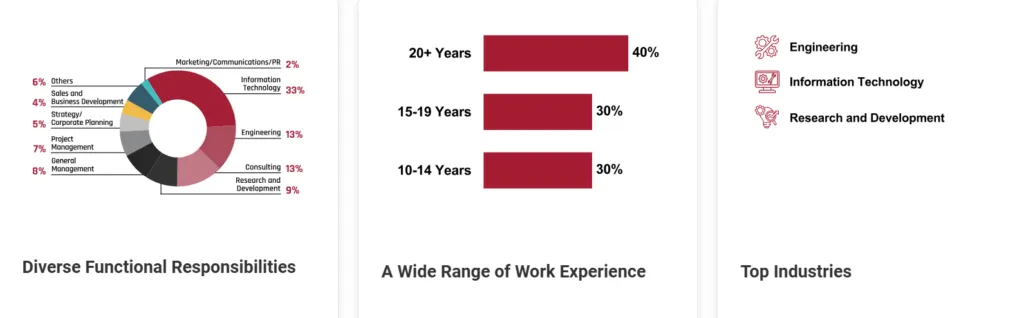
Yes. The MIT xPRO Designing and Building AI Products and Services program is tailored for product managers overseeing AI projects who want to deepen their technical fluency and design process expertise.
Read more: MIT AI Course Reviews
16. Can tech professionals in finance or health care benefit from this program?
Absolutely. The course equips professionals across industries to deliver AI solutions aligned with business needs.
17. Is this program useful for technology consultants?
Yes. Consultants will enhance their ability to recommend, design, and implement AI-driven solutions.
18. Is the course valuable for AI startup founders?
Yes. Founders gain a practical AI product development framework for creating scalable, user-focused solutions.
19. Can UI/UX designers benefit from this course?
Yes. Designers will explore how to shape intuitive, ethical user experiences for AI applications.
20. Do I need experience in AI or product management to join?
Not necessarily. The course is suitable for professionals looking to upskill in AI and product design. However, participants are required to have basic knowledge of algebra, statistics, probability, and intermediate Python skills.
21. What are past participants saying about the program?
Past participants have highlighted that the MIT xPRO Designing and Building AI Products and Services program offers:
- Practical, real-world relevance: case studies, examples, and applications that clearly connect AI concepts to real business challenges across industries
- Hands-on learning: workbooks, quizzes, and coding exercises in Python/Jupyter that make abstract concepts tangible, even for non-technical learners
- A well-structured, end-to-end framework: a clear progression from fundamentals to advanced topics, building a holistic view of AI product design
- Engaging, knowledgeable instructors: expert professors and interactive office hours with teaching assistants such as Pol, Miruna, and Danny, bringing clarity and real-world insight
- Flexibility for busy professionals: self-paced modules, recorded lectures, and year-long access to materials to revisit and deepen understanding
- Strategic and business-oriented insights: tools and frameworks to evaluate AI’s applicability, build business cases, and align AI solutions with market and organizational needs
- Exposure to cutting-edge tools and concepts: exploration of modern AI platforms, including Claude, Writesonic, and Watson, along with discussions on ethics, bias, and emerging opportunities
“The best part of the program was all of the real-life examples provided on the application of AI and what it could mean for the future. It was eye-opening to see how technology is advancing at such a rapid pace and how it is changing our world.”
—Vanessa Fernandez, IT manager, SSAB
Assignments, projects, and certificate
22. What types of assignments or projects are included?
Expect coding exercises in Jupyter Notebook, interactive workbooks, and a final capstone project in which you develop an AI product proposal.
23. What is the capstone project in this program?
You will apply the complete AI product design framework to pitch an AI-powered product or service.
24. Will I get a certification from MIT?
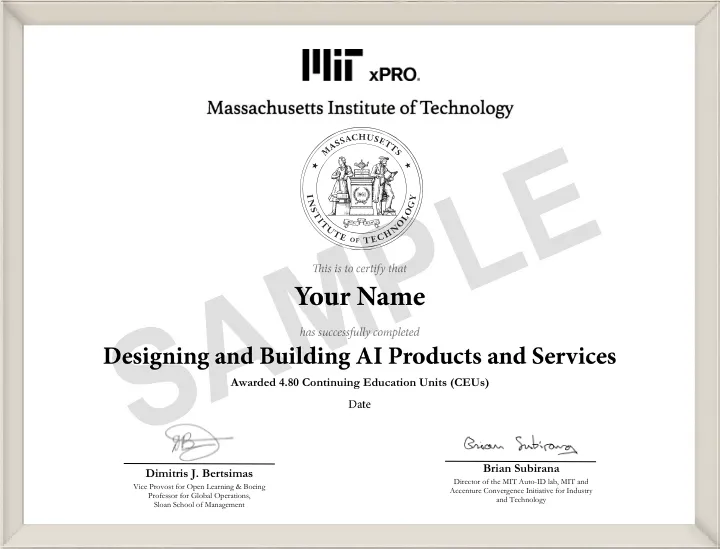
This program does not offer a certification. Instead, you receive a certificate of completion from MIT xPRO and 4.8 continuing education units (CEUs) upon passing the course. Your certificate is a credible symbol of your commitment to mastering AI product design and implementation. The CEUs can be used to demonstrate continuing professional development for employers, industry bodies, or licensing boards that recognize CEUs.
25. Is there feedback or peer interaction during the course?
Yes. Personalized feedback, peer forums, and live support are built in.
26. Can I speak with a program advisor before enrolling?
Yes. You can schedule a call with a program advisor to discuss fit and goals. Fill out the form on the program homepage, and you will receive a callback shortly.
Faculty and learning support
27. Who teaches the MIT xPRO AI program?
The faculty comprises experts who are leaders in AI, human-computer interaction (HCI), and machine learning. They include:
Brian Subirana: AI and IoT researcher with dual MIT Sloan and Engineering teaching experience, and former director of the MIT Auto-ID Lab
Andrew Lippman: senior scientist at the MIT Media Lab, known for groundbreaking work in digital media, communication, and immersive interfaces
Thomas W. Malone: pioneer in collective intelligence and AI-driven organizational design and the founding director of the MIT Center for Collective Intelligence
Duane Boning: MIT professor and expert in machine learning applications for advanced manufacturing and systems modeling
Stefanie Mueller: award-winning MIT researcher specializing in HCI and personal fabrication technologies
Bruce Lawler: MIT Machine Intelligence for Manufacturing and Operations (MIMO) managing director and tech entrepreneur with deep expertise in operationalizing AI in industrial settings
28. Is there interaction with instructors or mentors?
Yes. Weekly office hours and learning facilitator support are included.
29. Can I get technical help during the course?
Yes. Support is available for both technical issues and concept clarification.
30. Is there a peer discussion forum or community?
Yes. Peer-to-peer learning is encouraged through community forums.
Program fees and employer support
31. What is the tuition for the MIT xPRO AI product design course?
For the most accurate and up-to-date information regarding the program fee, visit the official program page.
32. Is the fee refundable if I defer or withdraw?
Refund policies are managed by Emeritus and may vary. Contact a program advisor before applying.
33. Can I pay in installments?
Yes. Payment plans are available.
34. Are travel or in-person components required?
No. The course is fully online.
35. Can my employer sponsor the course?
Yes. Many learners use corporate learning budgets to enroll. Visit the program page to access the employer sponsorship guide for approaching your organization.
Career impact and outcomes
36. Will this course help me advance my AI career?
Yes. You will gain market-ready skills and a portfolio-ready AI product proposal.
37. Does the program help with job applications or pitching ideas?
The program does not provide direct assistance in securing a job, but it enhances your AI design skills through a practical and hands-on approach to learning generative AI and ML tools. These skills give you an edge in the competitive job market. The final capstone project can also be used to pitch to stakeholders, clients, or investors.
38. Are there job placement or alumni benefits available?
While job placement and alumni benefits are not included, you gain access to a global network of peers.
39. Is the MIT xPRO certificate valuable to employers?
Yes. The certificate signals expertise in designing AI solutions and applying product thinking.
Technical and platform access
40. What platforms or tools will I use in this course?
You will use Jupyter Notebook for coding and the Emeritus platform for video content and interaction.
41. Can I access materials offline?
Some resources may be downloadable, but internet access is required for most components.
42. Are there any platform or system requirements?
A computer with internet access and a web browser is sufficient.
Reviews and learner experience
43. How do learners rate the MIT xPRO AI program?
Past participants praise its balance of theory and real-world application, with many citing career impact.
Highlighting how the program helps learners explore “challenging but practical cases” that furnish actionable ideas for business contexts, Daria Astapova, a project manager at Awin Global, said:
44. Is the course more theoretical or practical?
It blends AI theory with practical, hands-on product design exercises. The capstone project provides you with the opportunity to bring your AI-driven ideas to life, as Dr. Renata Jovanovic, a partner at Deloitte and its global quantum ambassador, said:
45. Do students feel prepared to design AI products after the course?
Yes. Learners report increased confidence in managing or contributing to AI product teams.
“The program allows for innovative problem-solving through advanced technologies, fostering creativity and pushing the boundaries of what’s possible in addressing real-world challenges. This process not only sharpens technical skills but also promotes collaboration, ethical considerations, and continuous learning—essential elements for delivering meaningful solutions in the dynamic field of AI.”
—Damilola Ogundele, technical product manager, Visa Inc.
46. Can I network with peers or instructors?
Office hours, discussions, and collaborative activities offer opportunities for networking.
“The frequent networking sessions help me stay in tune with the whole group. The content has good depth; overall, it’s amazing content.”
—Krishna Gedela, data architect, Gainsight
Additional FAQs
47. What is an AI product design course?
An AI product design course teaches you how to combine AI technologies—such as machine learning and generative AI—with business strategy and user experience to create real-world products and services.
48. Who should take an AI product design course?
AI product design courses, such as the MIT xPRO Designing and Building AI Products and Services program, are ideal for product managers, technology professionals, designers, consultants, and startup founders looking to design or manage AI-driven solutions.
49. Why should I learn AI product design now?
AI is transforming every industry. Learning AI design principles now helps future-proof your skills and gives you an edge in building scalable, innovative, AI-powered products.
50. Can non-technical professionals learn AI product design?
Yes. While some coding is included, courses like the MIT xPRO Designing and Building AI Products and Services program are designed to help even nontechnical professionals understand the AI product design process, build business cases, and apply responsible AI practices.
51. What skills do I need to build AI products?
To build AI products, you need a combination of technical, strategic, and design skills. Technically, you should understand the capabilities and limitations of AI systems. Strategically, you need expertise in product strategy, market analysis, and business case development to ensure your AI solution addresses real-world needs. From a design perspective, expertise in human-centered design, user experience, and ethical AI considerations ensures your product is both usable and trustworthy.
The MIT xPRO AI product design course builds on these foundations—teaching you a structured AI design process to take ideas from concept to scalable, market-ready solutions.
52. What’s the difference between designing AI and developing AI?
Developing AI focuses on creating algorithms and models. Designing AI focuses on applying those models to real user needs, business goals, and ethical contexts.
The future of AI is about creating solutions that deliver real value for people and businesses. If you are ready to bridge the gap between machine learning and meaningful product design, the MIT xPRO AI product design course offers the tools, frameworks, and faculty to help you make that leap.
Explore the MIT xPRO Designing and Building AI Products and Services program to gain the expert edge you need to innovate and lead AI project ideas.