
Competency Frameworks Were Built for a Different Era: Here’s What Needs to Change
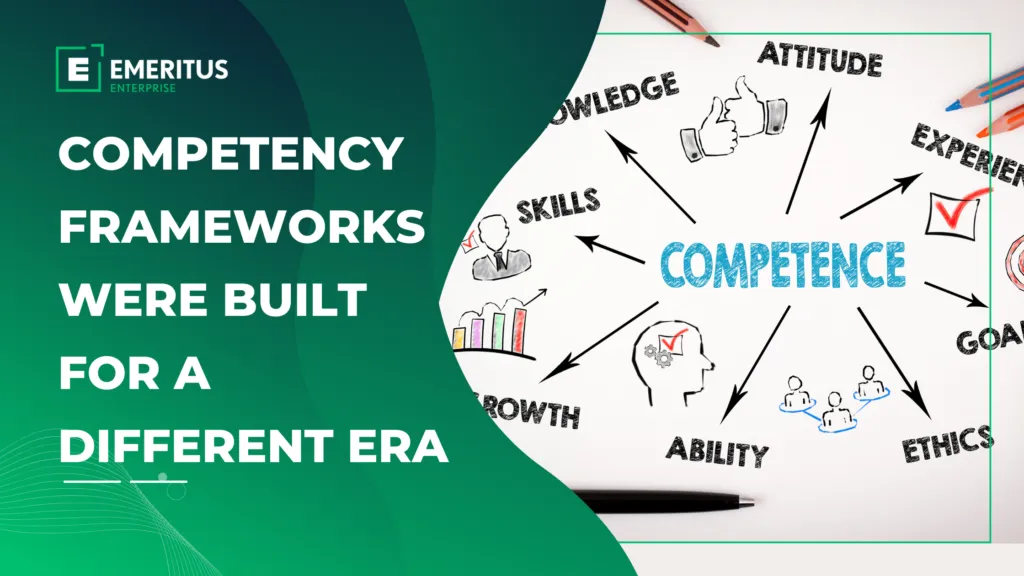
Competency frameworks are one of the most widely used tools in HR and L&D. They are also, in many organizations, one of the most quietly ineffective.
The promise is straightforward: define the behaviors and capabilities that drive performance, assess employees against them, identify gaps, and develop accordingly. In theory, it is a clean, logical system. In practice, most competency frameworks are out of date before they are fully implemented, disconnected from the actual work people do, and evaluated in ways that measure confidence in self-assessment more than real capability.
And yet organizations continue to invest in them, updating the language, refreshing the levels, and rebranding the framework, while the underlying problem remains unaddressed.
The issue is not competency frameworks themselves. It is the assumption that a static list of defined behaviors can keep pace with the rate at which work is changing.
Competency frameworks still play an important role in creating organizational consistency, particularly in compliance-heavy industries, regulated environments, early-career standardization, and technical certification pathways. But consistency alone is no longer enough. In an environment where AI is reshaping roles faster than job descriptions can be rewritten, where the skills needed in 2026 look materially different from those needed in 2023, the traditional competency model is structurally unsuited to the full scope of the task.
What Competency Frameworks Were Built For
To understand why competency frameworks are struggling, it helps to understand what they were designed to do. The modern competency framework emerged from the organizational psychology research of the 1970s and 1980s, most notably David McClelland’s work on identifying the characteristics that differentiate high performers from average ones. The goal was to move beyond credentials and IQ as proxies for performance, and toward a more behaviorally grounded understanding of what effective work actually looks like. For much of the late twentieth century, this was a genuine improvement. In organizations with stable roles, predictable workflows, and long employment tenures, a well-designed competency framework could anchor talent decisions, development investments, and performance conversations in something meaningful.
That organizational context no longer exists for most companies. Roles are evolving continuously. The half-life of specific skills is shortening. And the behaviors that defined high performance in 2019 may be table stakes, or irrelevant, by 2027.
The Three Ways Competency Frameworks Fail in Practice
The first failure is the speed problem. Most competency frameworks take twelve to eighteen months to design, validate, and implement. By the time they are embedded in talent processes, the organizational context they were built to reflect has already shifted. In fast-moving sectors, this lag means organizations are systematically developing yesterday’s capabilities.
The second failure is the measurement problem. Competency assessment typically relies on manager ratings, self-assessments, or 360 reviews, all of which are vulnerable to bias, inconsistency, and the social dynamics of the workplace. A 2022 CEB analysis found that manager ratings of employee competencies explained less than 30% of variance in actual performance outcomes. The framework gives the appearance of rigor without delivering it.
The third failure is what you might call the edge case problem. Competency frameworks define what good looks like in expected situations. They tell you very little about how someone performs when the situation doesn’t fit the script, which, increasingly, is where the most consequential work happens.
Consider a senior marketing manager navigating the shift to AI-generated content. No competency framework written in 2021 anticipated that role. The manager who thrives is not the one who scores highest against legacy behavioral anchors. It is the one who can assess the new landscape quickly, make judgment calls under uncertainty, and bring their team through an ambiguous transition without losing momentum. That capability is almost entirely invisible in traditional assessment tools.

What Organizations Should Measure Instead
The alternative is not to abandon structured capability assessment. It is to shift from measuring what someone knows today to understanding how well they develop as conditions change.
This means reorienting talent and L&D systems around three different questions.
Instead of asking, “Does this person demonstrate competency X?”, ask: How quickly does this person build new capability when the context shifts?
Research from Korn Ferry identifies learning agility, the speed and effectiveness with which someone develops in response to new challenges, as the single most important factor in long-term leadership effectiveness. It out predicts any static competency score.
Instead of asking, “How well does this person perform against defined behavioral anchors?”, ask: How does this person perform when the situation is ambiguous?
The ability to make sound decisions with incomplete information, in novel contexts, under pressure, is what differentiates sustained high performance. It is also what most competency frameworks cannot see.
Instead of asking, “What skills does this person have today?”, ask: What is this person’s capacity to develop the skills the organization will need in two years?
Potential, not just current capability, needs to be a central input into talent decisions and development investment.
The Implication for L&D
Shifting toward capability development requires L&D to change not just its frameworks, but its operating model.
Programs designed to close defined competency gaps, which is what most training catalogues are built around, are not well suited to building the judgment and learning capacity that organizations increasingly need. Those capabilities develop through stretch experiences, challenge, reflection, and feedback, not through courses mapped to behavioral anchors.
It also requires L&D to get more comfortable with outcomes that are harder to measure in the short term. Judgment quality and the capacity to adapt do not show up in completion dashboards or post-training satisfaction scores. They show up in performance over time, which means L&D needs longer measurement horizons and stronger partnerships with business leaders to track impact meaningfully.
The organizations that make this shift will not just have more capable workforces. They will have workforces that remain capable as the environment continues to change, which, by any current indicator, it will.

How Emeritus Enterprise Can Help
At Emeritus Enterprise, we work with L&D and HR leaders who are ready to move beyond the limitations of static capability frameworks. Our enterprise learning solutions are designed to develop the judgment, learning agility, and contextual thinking that drive sustained performance, not just point-in-time proficiency.
From strategic leadership programs to AI adoption journeys built around genuine fluency rather than tool familiarity, our customized solutions are grounded in how capability actually develops.
If your organization is ready to ask better questions about capability, we are ready to help you build programs worth investing in.
Get in touch with us to explore how Emeritus can support your workforce transformation and leadership development goals.