
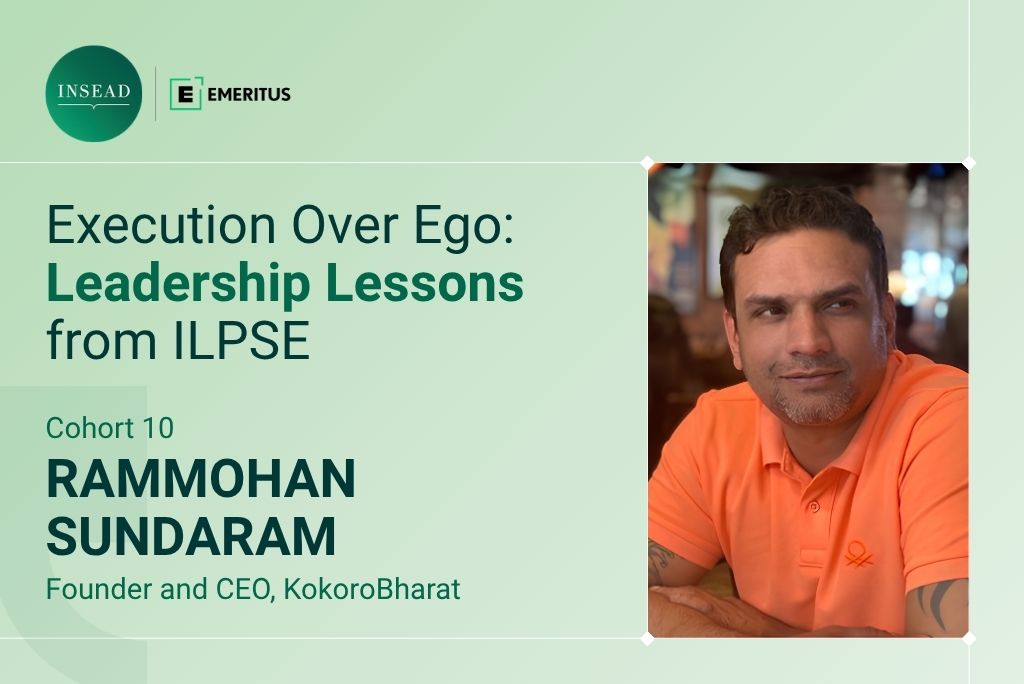
Execution Over Ego: Leadership Lessons Rammohan Sundaram Took From ILPSE
|
Synopsis Rammohan Sundaram, a three-time founder with two exits behind him, walks through how INSEAD ILPSE changed his leadership approach, and how it plays out today as he builds KOKORO Bharat from the ground up. |
Rammohan Sundaram explored the INSEAD Leadership Programme for Senior Executives – India (ILPSE) already three decades deep into a leadership journey—moving from ad sales into agency leadership, then into martech, and eventually into building companies of his own. Along the way, he held senior roles at organisations including Yahoo, Reliance Jio, and DDB Mudra Group, and founded three ventures, two of which ended in successful exits. For a leader with that record, ILPSE was about enhancing the skills and frameworks needed for the kind of leader he wanted to become next.
Rammohan enrolled in the 2021–22 ILPSE cohort while simultaneously pursuing three doctorates and another executive course. Two years later, he founded KOKORO Bharat, a home healthcare venture built to bring affordable, high-quality care to Indian homes. Here, he reflects on how ILPSE helped him build on his three decades of enriching leadership experience to carve a path to a successful entrepreneurial journey.

1. You’d already gathered three decades of leadership experience that include two successful startup exits before ILPSE. What made you explore this programme?
Most people think sales is about the pitch; the real process is transparency, listening to the other person, and then providing solutions. To do that properly, you have to know your product inside out, not just what it does, but why it was designed that way. That curiosity pulled me into product management, design thinking, and brand philosophy—I built relationships with marketing and research teams because I never wanted to sell something I didn’t fully understand.
I approached finance in the same way—seeking guidance from trusted colleagues and grounding my understanding in first principles. By the time I reached leadership roles, I already considered myself a general management person, simply because I’d exposed myself to all of it, and I was always revenue-driven — throughput matters in every department, even HR. Moving from role to role was never difficult for me. What I didn’t have was a structured space to turn all of that instinct into a deliberate leadership philosophy, and that is exactly what sent me looking at ILPSE.
2. You were completing another executive education programme and a doctorate simultaneously with ILPSE. What made ILPSE distinct from the rest of that academic load?
I took all three seriously, but ILPSE gave me three things I don’t think I gained anywhere else. The first was learning that you shouldn’t be the smartest person in every room. The second was around execution—that a founder’s greatest strength isn’t having the boldest vision, it’s building a culture where execution feels inevitable. And the third was EQ over IQ. Those three things were ILPSE’s takeaways for me specifically, which were more about life learnings in a different sense.
3. What is the one leadership lesson from ILPSE that has stayed with you the most?
The programme helped me become a far better leader because it helped me learn to help others solve problems I actually can’t solve myself. There are a lot of other people in the room who are smarter than you, and understanding that can make you a better leader. It’s a very personal takeaway for me, and it’s stayed with me since.
4. You founded KOKORO Bharat two years after ILPSE. How much of what you learned actually shaped the company, versus staying theoretical?
KOKORO Bharat itself grew out of a family health crisis that made it painfully clear how inaccessible affordable home care still is for most Indian families. But how I built the organisation around that mission is where ILPSE actually shows up.
You might have a great vision, but people actually follow people who consistently execute that vision in a very solid manner—that is something I took from ILPSE that I hadn’t fully learned anywhere else. You’ve got to lead from the front to get things off the block, and then leave the rest to the people in your organisation who are far more capable than you are at those specific jobs. You don’t need to do everything yourself, because you’re not always the smartest person in the room. That’s the same idea, just applied to how a company actually runs day to day.
5. Four years on, what does your ILPSE network actually look like today?
I am more connected with the faculty than with the people. Maybe it is the way I think, the way I relate to research, that makes me more comfortable with faculty than with constant peer catch-ups.
Both the programme directors are now investors in my company. That relationship has since deepened well beyond the classroom—we recently co-published a research paper on AI in medicine, accepted by one of the top-ranked journals in the field. So the relationship I built with faculty ended up far stronger than with my batchmates, even though I have those buddy groups too.
6. Is there a specific moment from the programme that’s stayed vivid, even years later?
During the Europe Campus module in Fontainebleau, we had a full-day session with an external psychologist where we had to talk through our personal experiences of life. It was done in small groups—four of us in one, five in another.
Everybody had tears in their eyes because you don’t normally get to speak so openly about the things that happen in your life and how they shape you as a person. Once one person opened up, the others opened up a little more, too. It was very nicely conducted. That one really touched me.
Paddy’s Phoenix Encounter sessions were extraordinary as well. The book itself is wonderful—and the final case study on graduation day, after months of build-up, was something else entirely. You are thinking about graduation later that same day, but you still have to put everything into the case from eight in the morning until five in the evening.
7. You’ve said EQ has become more important to you than IQ. Can you elaborate?
My connections with people have always been more personal in nature, so the emotional quotient was far more important for me than IQ. Earlier in my career, I tended to be quite an impatient leader. At that time, it worked, but in today’s world, it doesn’t. You’ve got to let certain things happen and take their due course. That is something I took as a direct learning from ILPSE, and I carry it into how we think about empathy at KOKORO Bharat.
8. Who do you think ILPSE is actually built for?
Having gone through it myself, I can tell you ILPSE is suitable for people with ten or more years of experience and have an MBA degree, but who haven’t been in touch with their academics for a while. With so much changing in today’s world, the programme provides a valuable opportunity to enhance their capabilities and stay relevant.
9. What would you tell someone considering ILPSE today?
If you’re joining purely to move the needle on your salary, this isn’t the right reason to do it. But if your goal is to become a better leader and a better version of yourself, the compensation follows naturally. You start performing differently, your organisation takes notice, and a promotion, a raise, or a stronger opportunity elsewhere becomes the outcome, not the objective. My advice to anyone weighing this decision: if you want to lead better than you did yesterday, this is worth the investment.
Sundaram didn’t need ILPSE to learn how to sell, build a brand, or run a P&L—three decades and three ventures had already taught him that. What the programme gave him was the discipline to stop being the smartest person in the room, and the conviction that a leader’s real currency isn’t vision; it’s execution people can trust. That shift shows up daily at KOKORO Bharat, in a culture built less around his own boldness and more around what his team can actually deliver. Three decades have built the operator. One year at ILPSE has built the human being running the company today.