
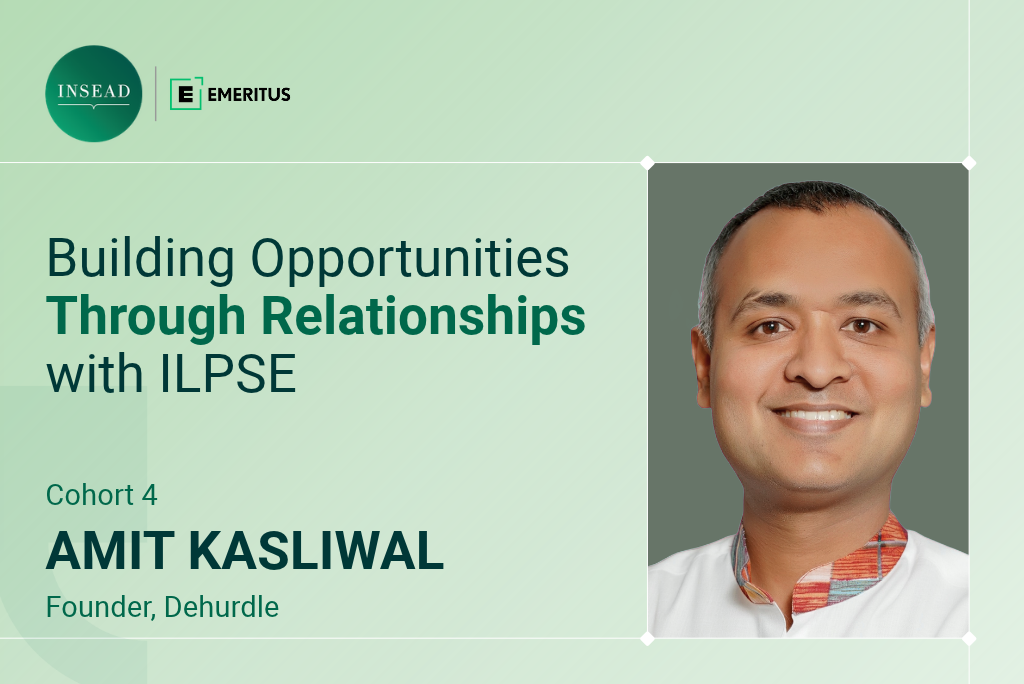
How INSEAD ILPSE Helped Amit Kasliwal Build a Speaker Profile beyond His Corporate Role
|
Synopsis: A faculty session on networking in the INSEAD Leadership Programme for Senior Executives – India (ILPSE) changed Amit Kasliwal’s approach to building relationships with peers. This eventually landed him opportunities to host alumni events and deliver speeches at business schools. It laid the foundation for his speaker profile that supported his entrepreneurial journey. |
A conversation with his mentor prompted Amit Kasliwal to explore executive programmes, which he hoped could be the next step in his corporate career. However, the INSEAD Leadership Programme for Senior Executives – India (ILPSE) helped Kasliwal, then Head of Corporate Sales at Ford India, build more than just a road map to corporate succession. A networking class in this executive leadership programme from INSEAD challenged Kasliwal’s transactional approach to relationships. He began hosting alumni events, sharing those experiences on LinkedIn and receiving invitations to speak. Alongside his corporate role, he was discovering opportunities he had not set out to pursue.
Kasliwal graduated from the INSEAD ILPSE in 2016 and left Ford in 2019. Today, he is the founder of Dehurdle, an AI voice-simulation platform that helps professionals develop workplace skills. In this conversation, he reflects on the class that stayed with him, his first speaking invitation and the relationships that supported his next chapter.

What prompted you to consider an executive leadership programme from INSEAD, such as ILPSE?
It started with a conversation with my mentor. He told me it was time to build new skills and suggested I ask my wife about my strengths and weaknesses.
I was not entirely sure what I was getting into, but I am a risk taker. At the beginning, the INSEAD brand was a big part of the appeal. I thought it would help me move into more senior roles. I was excited and motivated going in. I had already started reaching out and building relationships before the programme began. During the programme, I also took the initiative to bring speakers into our cohort sessions.
You joined with career progression in mind. What began to change that perspective?
Professor Bala Vissa’s session on networking in Singapore had a deep impact on me instantly. His point was that, despite having skills, if you have a limited number of people around you, you are a frog in a well. His point was that, despite having skills, if you have a limited number of people around you, you are a frog in a well. I was lucky to have the skills to reach out, and I was comfortable doing it, but I had never tried. I fell in love with that class. I lacked the ability to present myself and was very transactional in my approach towards relationships. Over time, I learned that relationships are very important, that giving is more important than asking and that helping others is more important than seeking.
How did you put the learning that you gained from INSEAD’s executive leadership programme into networking and speaking?
I put the networking lessons into practice by informally helping with INSEAD alumni events in India and then hosting networking events of my own. I began approaching relationships with more emphasis on giving and helping others, rather than asking for something.
I would post about these events on LinkedIn, with no idea that they would lead to speaking assignments. My following grew, and people began noticing what I was doing. When my first speaking invitation came, I drew on what I had learned in ILPSE. The session went well, I shared the pictures on LinkedIn and another invitation followed.
How did your first speaking invitation come about?
I believe that my visibility on LinkedIn earned me a speaking invitation from Sajan Dastogi at Indian Institute of Management Kashipur. My first talk was about leading yourself, leading others and leading business – topics that were covered in ILPSE. The session went well; I posted the pictures on LinkedIn, and another invitation followed.
I started enjoying it. When I visited my hometown, I walked into a few colleges, and a Common Admission Test training institute invited me too. That was how the flywheel started. The more I did it, the more invitations I received.
Beyond networking, how did ILPSE help you become more self-aware?
The Beneath the Surface session was a huge eye-opener. You can get caught up in your own judgements and assumptions. You see what you want to see and hear what you want to hear, without recognising how much you might be missing.
For me, another important takeaway was learning how to learn. You become more aware of your strengths and the areas in which you are not as strong. You also begin to recognise where it makes more sense to partner and collaborate.
When I joined, I had many doubts and limiting beliefs. Over time, I became more confident and assured. I began to believe I could create opportunities for myself rather than wait for them. The way I communicated and presented myself changed too.
How did INSEAD’s executive leadership programme support your transition from a corporate career to entrepreneurship?
The INSEAD Leadership Programme for Senior Executives – India (ILPSE) boosted my confidence to explore a different career path. After leaving Ford, I started as a trainer and speaker but soon realised that was not what I wanted to keep doing. I did not see it as a scalable model, so I raised a little money and began building a startup. There were failures and pivots along the way. My initial investment and first few customers came through the INSEAD network. Alumni also helped me work through questions around equity and other aspects of building an organisation.
It has been a roller-coaster journey, with failures and pivots along the way. ILPSE gave me the confidence to navigate those setbacks and a network that supported me as I refined the business. But of course, entrepreneurship also calls for timing, a strong team, early traction, backing, perseverance and resilience.
Looking back, is there an ILPSE experience that connects with what you are building today?
In the final module in Fontainebleau, we did a drawing exercise. Looking back at what I drew in 2016, I can see my life moving in that direction.
I had drawn myself supporting people as they walked along a path. That is what Dehurdle is doing today – helping people upskill.
The INSEAD Leadership Programme for Senior Executives – India (ILPSE) instilled in me the purpose and technique of people development through technology. That has helped me stay resilient through the ups and downs of entrepreneurship. I am also participating in global forums and building relationships with INSEAD alumni around the world as I aspire to take Dehurdle beyond India.
What would you say to someone weighing whether ILPSE is worth the investment?
Evaluate it in your own context. Talk to five or ten alumni and understand where they have found value.
I speak with people who are considering the programme, but I am not there to convince them one way or another. My story is unique, and everyone has their own discovery.
For me, the INSEAD alumni network has been very responsive. I am happy with what I have gained and what I have been able to contribute. There are great people to work with and build relationships with. My own experience has been very positive.
Amit Kasliwal did not join the INSEAD Leadership Programme for Senior Executives – India (ILPSE) with plans to become a speaker or founder. He wanted to move ahead in his corporate career. What changed was how he approached people: less transactionally, with more emphasis on giving and building relationships. He put that learning into practice by hosting events and reaching out, and the speaking invitations followed. When he later began building Dehurdle, the INSEAD network supported him with early investment, customers and advice. His story is not simply about the doors a programme can open. It is about what happens when a participant takes learning beyond the classroom and continues to act on it.