
How the INSEAD Executive Development Programme Built the Confidence to Step Into a Director Role
|
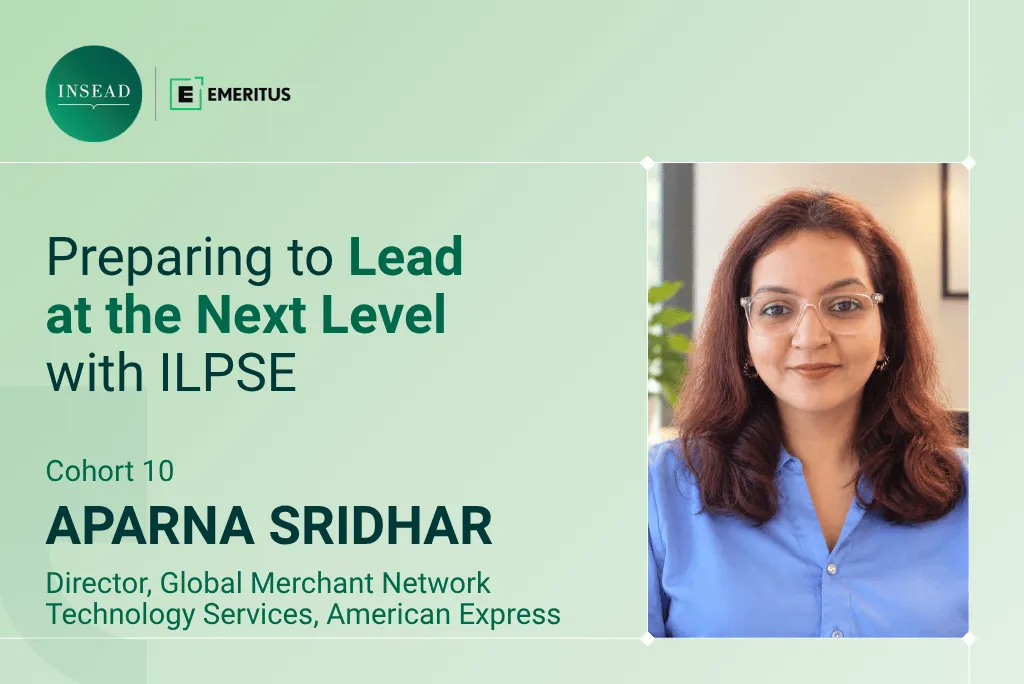
Synopsis: ILPSE, an executive development programme, gave Aparna Sridhar, a ten-year Amex veteran, the confidence and perspective she needed to move into a director role. Here, Aparna Sridhar, Director at American Express, reflects on what specifically shaped this career progression. |
Transitioning from a managerial role to a director-level position is never entirely about performance alone. For Aparna Sridhar, it was first about readiness, as she wanted to be certain she was ready for the role before applying for it.
Aparna Sridhar has spent her entire career at American Express, and the organisation gave her plenty of room to grow – from an analyst role through advertising and promotions to building an entirely new department in India from scratch and eventually moving into technology operations despite no formal technical background. But by her own admission, every one of those moves happened inside the same organisation, and at a certain point, internal growth alone could not give her the outside perspective she needed before she would feel ready for the next level.
To prepare for the Director role, she enrolled in the INSEAD Leadership Programme for Senior Executives – India (ILPSE), an executive development programme, and graduated in 2022. She became a director in December 2024. Here, she reflects on how the programme prepared her, from her decision to enroll and the cohort experience to the feedback process and exercises that shaped her.


As you aimed for a director role, what made an executive development programme the right next step?
Amex is where I built my career, and my leaders had faith in me and kept pushing me towards leadership roles. Once I was leading team leaders, I was very clear that the next level, director, would need formal education – a leadership programme and eventually a master’s. I talked to a lot of people I knew in the organisation, including directors and vice presidents, and noticed that they all had an MBA degree. I knew the education I had was not going to be enough to take me forward. A significant span of my career had also been at Amex, so my knowledge was limited to what the organisation does. An executive development programme was an opportunity for me to stretch my knowledge and perspective beyond my current threshold. I felt that it could be a potential outlet for actionable insights and understanding that would prepare me for a director role.
Once you had decided on a programme, what led you to choose ILPSE?
I wanted international exposure. When I went through the interview rounds and spoke with alumni, ILPSE felt like the better fit for me. As I aimed for a director role, it could not be about one domain. I needed to look at industry-wide experiences and multiple industries across regions. That might not directly help me in my role, but it helps me think better as a leader and think beyond what I do today.
Once the programme began, how did learning alongside a cohort of senior leaders from different industries prepare you for the next stage of your career?
I am an extrovert, so I enjoy talking to people and networking, and it lets me learn a lot about what others are doing. The cohort was a mix of people from the military services, doctors and professionals from marketing, advertising, insurance, logistics and HR. They had years of experience: I had about ten, and the average was around 17 or 18. Talking to them helped me develop my thinking on how things operate at senior leadership levels, how to gather more knowledge about industries and share it, and how to grow as a person and as a leader. For the first time, I got to see many different leadership styles and ask myself: will this style work for me? Is this the kind of leader I want to work with or grow into? What combination of skills makes a more effective, engaging leader for my team, whichever career choices I make?
Beyond the cohort, which ILPSE exercises stretched you the most?
As part of the leadership section, we had some very candid sessions, including icebreakers in which we had to present. It made me so much more comfortable that today I will not think twice about speaking in front of a large audience and presenting my views. At the time, I was sure I would falter, but these sessions gave me a lot of confidence that I did not have before.
Then there was the Below the Surface exercise we did in Mumbai, which was the most difficult one of all. It brought out the rawest emotions I have buried deep inside. It shook up my subconscious to such a level that it changed me as a person.
ILPSE also includes a Business Leader Interview, where each participant sits down with a senior business leader they respect and admire. Whom did you choose, and what did you take from it?
I asked to be paired with Rajneesh Virmani, the former CPO of Amex India, so it was very comfortable to talk to him and learn from his experience. He could relate to what I shared, and he guided me in a way that helped me understand more about myself and the management. This conversation helped me develop my soft skills, both as a person and as a leader.
The executive development programme’s Global Executive Leadership Mirror (GELM) 360° feedback process ran alongside all of this. What did it show you?
We filled out a survey at the start of the programme and revisited it a year later, and again a year after that because our programme ran a little longer. Reading what I had written earlier next to what I was writing later, I could see the difference myself. Since I had asked my reporting manager to track my progress, I then asked him directly whether he saw a difference. He said he saw immense growth, and he validated that I was ready for a leadership role.
Did ILPSE play a direct role in your move to director?
It did, immensely. I was waiting for a role to open up because we had set up this team in India and a director role was eventually going to open here. Somewhere in the back of my mind, I knew I would apply for it, and I was very confident I would get it. That confidence came from the way the programme changed my aptitude and mindset to look, think, and act beyond my previous role. I moved into the role in December 2024.
Looking back, which parts of this executive development programme have stayed most useful, and do you expect them to remain relevant?
I loved the private equity topic, even though it is not my domain, and the faculty-led sessions, including one with a visiting professor. Finance is part of everyone’s job on any given day in a senior role. It helps me when my team is working on budgets because I can understand what is being used where, what expense is going through and how it comes back as revenue.
As for relevance, the subjects the programme covers are pillars in themselves and they are not going away: digital marketing, advertising, private equity, economics, finance and disruption. The Phoenix Encounter method should also continue.
What would you tell someone considering an executive development programme such as ILPSE?
Do not expect things to be handed to you on a plate. You have to work for it, be engaging enough and take the leap yourself. Make the programme work for yourself. Find your own ground, understand exactly what you are studying and talk to your peers because you cannot do this by yourself. It is an engaging programme, not one driven by silos, and it helps you grow as a person and as a leader. Approach it for the knowledge and experience it gives you, and the growth will come in any form.
For Aparna Sridhar, ILPSE gave a clearer view of the type of leader she wanted to become – and the confidence to act on it.
The cohort exposed her to leadership approaches beyond her own organisation and industry. The executive development programme’s exercises helped her become more assured in high-stakes communication. Additionally, the GELM 360° feedback process gave her a tangible way to see and articulate her growth over time.
Together, those experiences helped Aparna Sridhar move from wondering whether she was ready for a director role to believing she could take it on and ultimately stepping into the role she wanted. When the opportunity emerged, she had the perspective, self-awareness and confidence to put herself forward and to step into the role with conviction.





 Emeritus Online Courses
 Emeritus India
 Emeritus SG