
A Multi-Tiered Approach to Leadership and Succession Strategy
- Understanding the Need: One Size Doesn’t Fit All
- 1. Accelerate Program: Building Foundations for Mid-Level Managers
- 2. Advance Program: Elevating Senior Leaders to Change Agents
- 3. Achieve Program: Enabling Country Leaders for Strategic Impact
- Design Considerations: Why This Structure Worked
- From Capability to Culture
This article explores multi-tiered leadership development, leadership development frameworks, and tiered leadership programs.
In a fast-paced global organization, ensuring that leadership at every level is equipped to meet evolving business demands is not just an advantage—it’s a necessity. That was the challenge faced by one of the world’s most recognized consumer brands. With operations spanning regions and teams at different stages of growth, the organization needed a leadership development solution that was scalable, contextual, and future-focused.
To address this, Emeritus co-created a comprehensive, three-tiered leadership program framework designed to build capabilities for mid-level leaders, senior leaders, and country leaders.
The objective: empower these leaders with the tools, mindset, and support to drive transformation, accelerate decision-making, and foster long-term business impact.
Understanding the Need: One Size Doesn’t Fit All
The client recognized that leadership development must be tailored—not only to the level of seniority but also to the strategic challenges faced by each cohort.
Mid-level managers needed help with team leadership, internal influence, and cross-functional collaboration. Senior leaders were expected to lead organizational change and culture transformation. Country leaders, meanwhile, were in positions of broad strategic influence, responsible for aligning national operations with global goals.
With these unique challenges in mind, Emeritus designed and delivered three flagship programs:
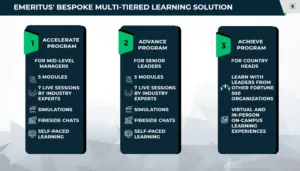
1. Accelerate Program: Building Foundations for Mid-Level Managers
This program was crafted to equip mid-level managers with the skills to make better decisions, lead high-performing teams, and build strong internal networks.
These leaders are the glue of the organization. Their ability to guide teams, align to business objectives, and collaborate across functions has a direct impact on operational effectiveness.
Impact: Up to 65% of participants noticed a significant improvement across 3 focus areas:
- Building and guiding teams
- Developing strategic, operational, and personal networks
- Accessing and analyzing data to develop better strategic plans
2. Advance Program: Elevating Senior Leaders to Change Agents
This program targeted senior leaders positioned to shape organizational culture, navigate complexity, develop their leadership styles, and drive change at scale.
These leaders operate at the intersection of strategy and execution. They influence culture, lead multifunctional teams, and must translate vision into impact. Many had grown within the system and needed fresh tools to approach transformation.
Impact: 80% of participants reported notable improvements in their ability to influence, lead change, and navigate organizational dynamics more effectively.
3. Achieve Program: Enabling Country Leaders for Strategic Impact
The most senior cohort—comprising country heads—needed a different kind of program: one that blended leadership with systems-level thinking.
These leaders had to align global strategy with local execution while managing business, people, and community impact. Their decisions often had long-term consequences.
Impact: Multiple participants from this program have taken up next-level management roles in the organization
Design Considerations: Why This Structure Worked
This leadership initiative wasn’t built in silos. It was designed to function as an interconnected framework that aligned with the organization’s broader succession strategy.
- Tiered by impact level: Each program aligned with the business contribution expected at that level.
- Role-relevant content: Modules and activities reflected real challenges faced by leaders on the ground.
- Mix of formats: From live expert-led sessions to self-paced learning, every format was selected to optimize engagement and retention.
- Cohort-based interaction: Peer learning added depth, perspective, and cross-functional insights.
- Faculty excellence: Delivered in collaboration with Columbia Business School and MIT Sloan, the programs reflected the best of academic and practical insight.
Leaders walked away with enhanced decision-making capability, stronger internal networks, and the confidence to navigate ambiguity.

From Capability to Culture
What emerged wasn’t just a set of better leaders—it was a more unified leadership culture. One where leadership wasn’t tied to title but to mindset and behavior. Where conversations were more strategic, collaboration more seamless, and change more proactive.
This initiative set the foundation for long-term leadership readiness. It showed how investing in tailored learning journeys—grounded in context, scaled through structure, and enriched by global expertise—can help companies meet the leadership challenge head-on.
If you’re building the next generation of leaders and want to co-create a similar leadership development journey aligned to your business goals, connect with the Emeritus Enterprise team. We’d be glad to partner with you in designing learning solutions that drive real impact across every level of your organization.