
Education, Transformation and Strategy: Why They Have Never Needed to Be More Hand-in-Hand Than in the AI Revolution
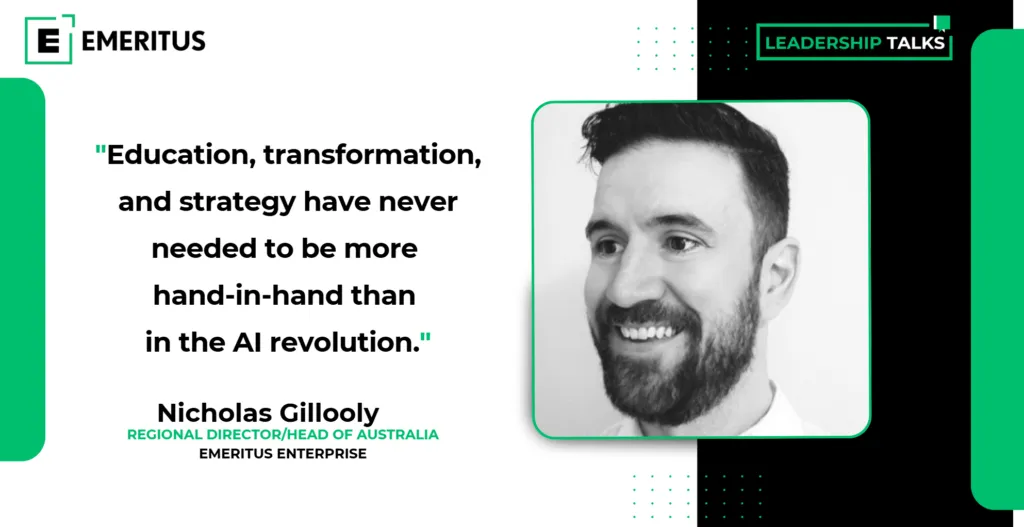
In this edition of Leadership Talks, Nicholas Gillooly, Regional Director/Head of Australia & New Zealand Enterprise Business at Emeritus, explores why education, transformation and strategy have never needed to be more hand-in-hand than in the AI revolution.
Artificial intelligence is creating a challenge that organisations have rarely faced before. At almost every level of the business, people are being asked to make decisions, lead change, and create value in a domain that is still relatively new to them.
Traditionally, organisations could establish a strategy, communicate it through management layers, and then build workforce capability over time. AI strategy is different because it’s so new – there is a hugely variable baseline of knowledge in exec groups. The people setting the strategy often need to learn about the technology while simultaneously deciding how it will reshape their organisations. The people executing the strategy are often learning the subject while being expected to lead others through change and set examples.
The Leadership Challenge: Setting Strategy in a New Domain
Most executives understand the strategic importance of AI. They recognise the opportunities around automation, decision support, operational efficiency, customer experience and innovation. However, recognising potential and developing a practical roadmap are very different things.
An effective AI strategy requires leaders to understand enough of the technology to set a meaningful AI direction for the organisation. They must:
- Identify and assess meaningful AI opportunities.
- Distinguish genuine value from market hype.
- Assess organisational readiness.
- Understand data requirements.
- Prioritise initiatives based on business outcomes.
- Make informed decisions around organisational change.
Without this knowledge, strategy can become disconnected from reality but education alone is not enough. Simply knowing about AI is not the same as setting your organisation’s AI direction.
At the Board/C-suite/Exco level, we need to combine education with strategy and transformation. Make the learning program a program where we can also create a strategy.
For example, we recently worked with a a C -suite team doing both education and planning at once. They completed a university-level AI certification while simultaneously working with AI strategy and technology specialists to develop their larger plan. So, as they learnt, they could immediately apply new knowledge to real business challenges. Education informed strategy, while strategy provided context and relevance for education.
Rather than occurring separately, learning and strategy formation reinforced each other.
The Engine Room: Where Strategy Becomes Reality
While Execs set the strategy, it needs to be executed throughout the whole organisation, and its most often middle and upper management who are the engine rooms of execution. These individuals often contribute to strategic planning while simultaneously carrying responsibility for execution- the era of AI transformation will be no different.
While senior leaders need development in strategic decision-making, operational leaders need a deeper understanding of how to identify and execute opportunities within their areas of responsibility.
Their education should focus on:
- AI opportunity identification.
- Opportunity assessment and prioritisation.
- Workflow redesign.
- Process optimisation.
- Automation opportunities.
- Change management.
- Measurement of outcomes and benefits.
The executors need enough understanding to identify where AI can create value, assess feasibility, engage technical teams effectively, and lead implementation efforts. Just like in the Exec group, teaching the engine room group AI skills will only take us so far. When we can link their learning to the execution of actual projects, in a feedback loop with exec strategy, that is where we see rapid improvements. Incorporating the execution of AI projects into AI is also the simplest way to measure RoI, as we can look at the return of individual projects.
In Conclusion – Knowing is Not Doing
The theme here is simple, a traditional approach in which we learn some technical elements of a new concept, then internalise them and then train gradually will be too slow for the current environment. In order to move towards AI enabled organisation, our learning approaches need to focus on actually forming and executing strategy and transformation.

How Emeritus Enterprise Can Help
This is the gap Emeritus Enterprise was built to close. We partner with organisations to design capability transformation journeys that bring education, strategy and execution together — mapping capability gaps to business priorities, architecting multi-modal learning journeys with leading global business schools, and deploying them at scale, so learning translates into measurable business impact rather than completed certificates. If your leadership team is navigating the gap between AI adoption and AI transformation, we’d welcome the conversation.