
From AI Adoption to Execution: Leading High-Performing Hybrid Teams
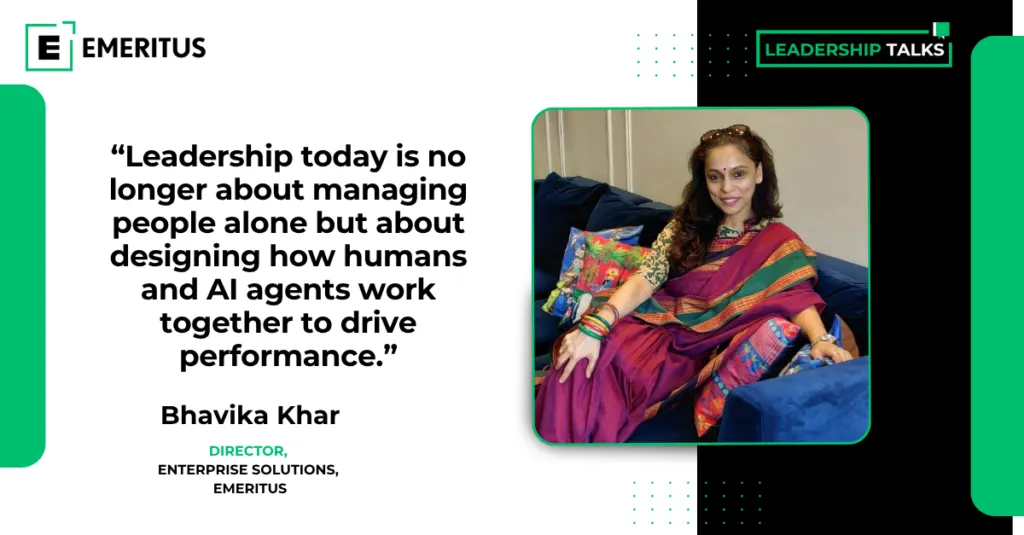
In this edition of Leadership Talks, Bhavika Khar, Director of Enterprise Solutions at Emeritus Enterprise, shares her perspective on the rise of hybrid teams—where humans and AI agents work side by side—and how leadership must evolve to translate AI adoption into real performance outcomes.
The Rise of Hybrid Teams
AI is no longer limited to experimentation. It is embedded in workflows, decision-making, and daily operations.
Organizations are now managing hybrid teams—comprising humans and AI agents such as copilots, automation tools, and systems generating real-time insights.
While adoption has accelerated, leadership capability has not kept pace. The challenge is no longer whether to use AI, but how to integrate it in ways that improve performance, maintain accountability, and scale effectively.
The Leadership Challenge
AI adoption has largely been driven by efficiency goals—automating tasks and accelerating output. But without changes in how work is managed, this often creates complexity.
Workflows become fragmented. Ownership between human and AI outputs is unclear. Teams struggle to balance AI recommendations with human judgment. Gains are often offset by rework or inconsistency.
Leaders must now deliver results while driving transformation—balancing speed, quality, and governance. Traditional management approaches are no longer sufficient. What’s needed is a shift in how work is designed and executed.
From Adoption to Work Design
Organizations seeing real impact are not layering AI onto existing processes—they are redesigning work.
AI handles routine and data-heavy tasks, while humans focus on strategy and decision-making. But this requires clarity on oversight and accountability.
Equally important is workflow integration. Poorly integrated AI creates duplication; well-integrated AI enables faster decisions and consistent execution.
This shift moves leadership from managing tasks to designing systems of work that combine human and machine capabilities.
Building Effective Human–AI Collaboration
The most effective organizations treat AI as part of the operating model.
Three factors are critical:
- Accountability: Clear ownership of outcomes when AI is involved
- Decision boundaries: Knowing when human judgment is required
- Trust: Building capability to interpret and apply AI outputs
When these are in place, AI becomes more than a productivity tool—it becomes a performance multiplier.

Scaling Capability in a Hybrid Workforce
AI enables organizations to scale capability across teams and geographies—providing access to insights and execution support at scale.
But this increases the need for capability building. Employees must learn not just how to use AI, but how to work with it—framing problems, evaluating outputs, and applying insights.
Organizations that invest in these capabilities move beyond short-term efficiency to sustained performance improvement.
What Changes When It Works
When hybrid teams are well designed:
- Decision-making becomes faster and more informed
- Execution becomes more consistent
- Leaders focus more on strategic priorities
- Teams collaborate and adapt more effectively
These are not just efficiency gains—they reflect stronger organizational capability.
Why This Matters for Leaders
Managing hybrid teams is a leadership capability.
Leaders must align AI with business priorities, redesign workflows, define roles and decision rights, and build capability across teams. Governance—ensuring accountability, transparency, and ethical use—is equally critical.
Organizations that do this well translate AI investment into measurable impact and long-term advantage.

Enabling Hybrid Capability at Scale
Emeritus Enterprise partners with organizations to design learning journeys that help leaders and teams integrate AI into workflows, redesign work models, and drive business outcomes.
The focus is not on understanding AI in isolation, but on applying it within real organizational contexts.
The shift to hybrid teams is already underway. The question is not whether to adopt AI, but how to lead effectively in this new model.
Organizations that can design and manage human–AI systems will be better positioned to execute, adapt, and grow.
If your organization is moving from AI adoption to execution, Emeritus Enterprise partners with leaders to build the capability needed to design and scale high-performing human–AI teams.