
Who Should Apply for the MIT xPRO AI Robotics Certificate Program?
|
Synopsis: This article discusses who should apply for the MIT xPRO AI robotics certificate program and how its integrated approach prepares professionals to design, evaluate, and lead real-world automation initiatives. |
Artificial intelligence and robotics are the primary drivers of automation that are revolutionizing every aspect of operations across industries. For individuals working across the organizational hierarchy, starting right from individual contribution to an executive capacity, the ability to understand and strategically apply AI and robotics is non-negotiable. Yet, most talent pipelines still treat these two areas separately.
The MIT xPRO Certificate Program in AI Product Design and Robotics Applications bridges that gap. This AI robotics certificate program integrates robotics and automation with AI product design, equipping participants with the frameworks, technical depth, and hands-on experience required to build scalable intelligent systems.
The MIT xPRO Certificate Program in AI Product Design and Robotics Applications at a Glance
| Key features | ROI for professionals |
|
|
Is the MIT xPRO AI Robotics Certificate Program Applicable to Your Career Goals?
Here’s a look at the diverse professionals—across roles, seniority levels, and responsibilities—who should opt for this robotics certificate program.
AI product managers and technical product leaders
Ideal for: Technical product managers, AI/ML leaders, innovation heads, and professionals overseeing intelligent product ecosystems.
Challenges they face:
- Managing AI-powered features without a deep understanding of learning algorithms
- Evaluating generative AI tools without clarity on system constraints
- Struggling to assess whether robotic automation initiatives are feasible
- Translating AI innovation into structured business cases
How this AI robotics certificate program helps:
- Builds fluency in supervised, unsupervised, and reinforcement learning models
- Strengthens understanding of neural networks and algorithms to create intelligent features
- Teaches you to evaluate the full AI design lifecycle—from problem definition to deployment
- Deepens knowledge of generative AI, RAG, and agentic systems
- Develops foundational insight into robotic system architecture, sensing, motion planning, and control
- Equips you to assess human–robot interaction implications in real-world deployments
- Helps you design structured business cases for robotics and automation initiatives
Program takeaway: Move from managing AI features to leading integrated intelligent systems—capable of aligning artificial intelligence, robotic automation, and product strategy within one cohesive framework.
Engineering and Robotics Professionals Seeking Strategic Growth
Ideal for: Robotics engineers, control engineers, automation engineers, software engineers, and professionals working in robotics and automation environments.
Challenges they face:
- Deep expertise in robot programs, but limited exposure to AI integration
- Working on subsystem-level robot design without full system visibility
- Difficulty articulating ROI for industrial robotics investments
- Limited understanding of how generative AI enhances robotic systems
How the AI robotics certificate program helps:
- Expands your perspective from component-level robot design to full-stack robotic system architecture
- Builds fluency in machine learning, reinforcement learning, and advanced learning algorithms
- Enhances your understanding of sensing, motion planning, and robotic automation control methods
- Connects robotics engineering principles with AI applications
- Strengthens your ability to evaluate industrial robotics deployment constraints
- Provides hands-on experience through coding exercises, simulations, and applied exercises
- Guides you in developing a capstone AI and robotics solution proposal grounded in real-world feasibility
Program takeaway: Gain the interdisciplinary expertise required to move beyond isolated robot programs and contribute to intelligent robotics systems that integrate AI, automation, and business impact.
Technical leaders and enterprise architects driving robotic automation
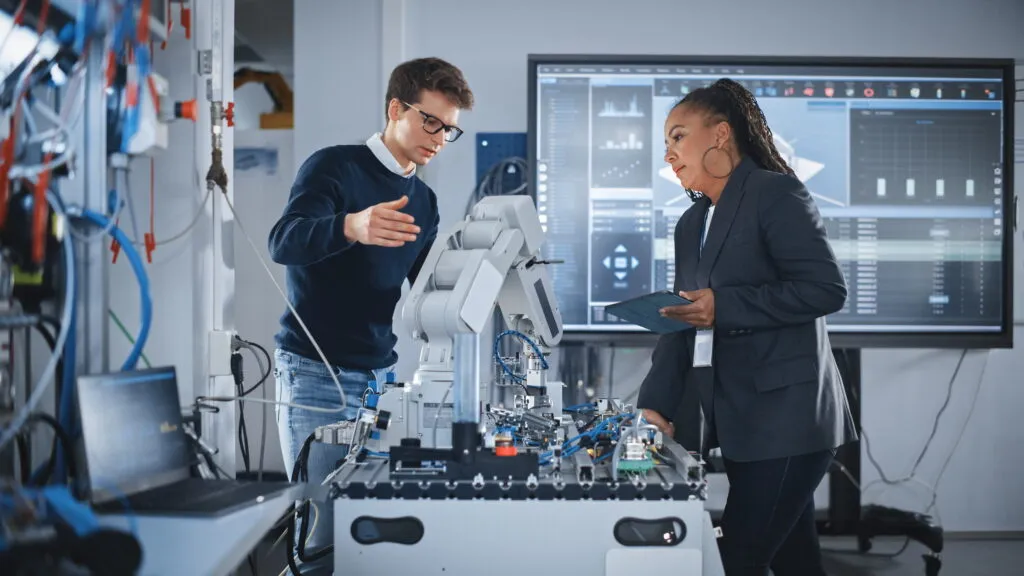
Ideal for: CTOs, directors of technology, enterprise architects, operations leaders, and decision-makers overseeing robotics and automation initiatives.
Challenges they face:
- Evaluating fragmented robotics stacks and AI investments
- Determining where robotic automation delivers measurable, real-world value
- Balancing scalability, safety, and ROI across automation projects
- Lacking structured frameworks to assess robotics applications at scale
How the robotics certificate program helps:
- Enables you to forecast AI and robotics applications within digital and physical systems
- Strengthens your ability to evaluate robotic system suitability for specific work tasks
- Builds understanding of autonomy levels, sensing architectures, and control mechanisms
- Enhances fluency in generative AI and scalable AI system design
- Provides structured frameworks to assess robotics certification-level knowledge without committing to a full degree program
- Uses case studies and applied exercises to ground automation strategy in real-world constraints
- Helps you design business cases for the AI and robotics initiatives
Program takeaway: Gain the technical clarity required to lead robotics and automation transformations confidently—without needing to pursue a full computer science degree program.
Entrepreneurs, founders, and innovation consultants in robotics applications
Ideal for: Startup founders, consultants, and innovators building AI-powered robotic systems across healthcare, logistics, manufacturing, construction, and energy.
Challenges they face:
- Identifying high-value AI robotics applications
- Moving from concept to scalable robotic automation
- Demonstrating technical credibility to investors
- Designing algorithms to create intelligent robotic solutions
How this AI robotics certificate program helps:
- Provides a structured framework for designing AI-based products and robotics applications
- Builds a strategic understanding of learning algorithms and reinforcement learning
- Strengthens your grasp of robot design, sensing, and planning models
- Enhances your ability to evaluate generative AI integration into robotics systems
- Offers hands-on experience through coding activities and system simulations
- Culminates in a capstone proposal ready for stakeholder or investor presentation
Program takeaway: Transition from AI-curious innovator to credible robotics automation strategist capable of building intelligent systems grounded in technical feasibility and real-world performance.
Who Will Benefit Most from the MIT xPRO Certificate Program in AI Product Design and Robotics Applications?
The MIT xPRO Certificate Program in AI Product Design and Robotics Applications is designed for professionals ready to build technical fluency in AI and robotic systems. The program is ideal if they:
- Have foundational knowledge in mathematics and statistics
- Are comfortable engaging with computer science concepts
- Have basic familiarity with Python
- Want to design robotic automation systems with real-world impact
The MIT xPRO AI robotics certificate program integrates AI product design with robotic systems thinking—reflecting how intelligent technologies actually function in real-world environments. Together, they represent a practical foundation for organizations investing in scalable automation.
This makes the program relevant across hierarchical levels. Technical professionals build deeper expertise in learning algorithms, robotic systems, and generative AI, while product leaders and executives gain structured frameworks to evaluate feasibility, risk, and long-term strategic impact.
By blending technological depth with broader business perspective, the program supports professionals seeking to operate confidently at both the implementation and decision-making levels—aligned with how AI and robotics are increasingly driving enterprise value.
Explore the MIT xPRO Certificate Program in AI Product Design and Robotics Applications to position yourself to lead at the intersection of AI and robotics.