
Wharton AI Course Curriculum Deep Dive
- How the Wharton AI Course Curriculum Is Structured
- What Does Phase 1: Data-Driven Decisions Cover?
- What Does Phase 2: Machine Learning and Applications Cover?
- What Does Phase 3: AI Inputs and Outputs Cover?
- What Does Phase 4: Data and Algorithms in the Organization Cover?
- What Does the Six-Week Leadership Short Course Cover?
- How Do GenAI Webinars Support the Wharton AI Course?
- What Else Is Included in the Wharton AI Course?
| Summary:
This article provides a structured walkthrough of the Wharton AI course curriculum, highlighting its core learning areas, applied components, and how it supports enterprise-level AI leadership. |
The Wharton Leadership Program in AI is a six-month program for senior leaders guiding AI-related decisions. Its curriculum covers data-driven decision-making, machine learning, responsible AI, data governance, GenAI, and workforce transformation. This article explains how the program is structured and what participants explore across each phase.
How the Wharton AI Course Curriculum Is Structured
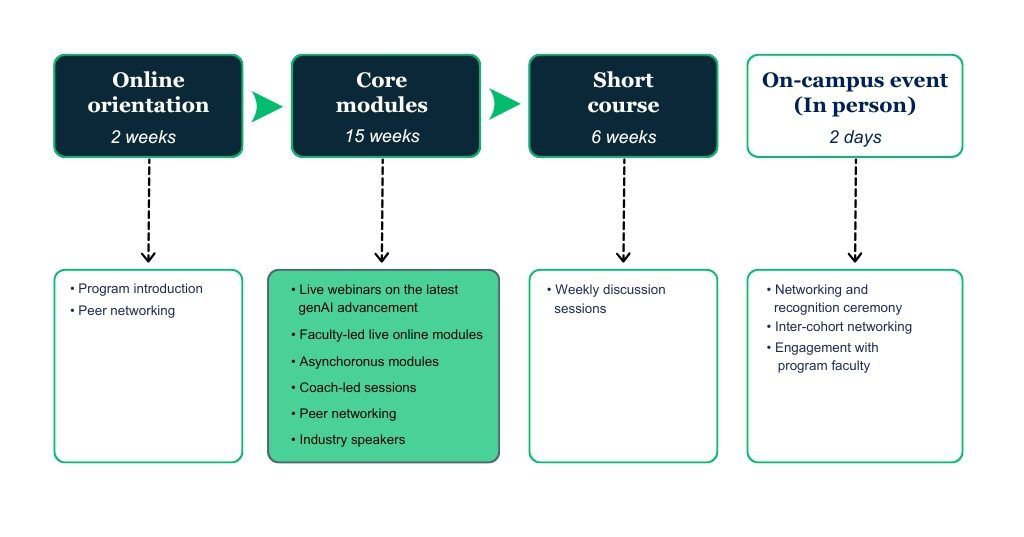
The Wharton AI course combines 15 weeks of core modules, a six-week leadership-focused short course, integrated GenAI webinars, and an organization-specific capstone project. The program is delivered through self-paced online learning, faculty-led live sessions, and applied learning components.
The program requires approximately four to six hours per week and is structured to fit alongside ongoing professional commitments.
| Phase/course | Duration and format | Learning focus | Applied element |
|---|---|---|---|
| Data-Driven Decisions | 3 weeks, online and live online | Data-driven decisions, AI landscape, market insights, and experimentation | Required faculty-led live session and required activity |
| Machine Learning and Applications | 5 weeks, online and live online | AI, ML, GenAI, LLMs, deep learning, prediction, and reinforcement learning | Business-focused AI and ML application |
| AI Inputs and Outputs | 5 weeks, online and live online | Business, legal, and ethical responsibilities, including responsible AI, bias, privacy, regulation, and workforce impact | Required faculty-led live session and real-world case studies |
| Data and Algorithms in the Organization | 2 weeks, online and live online | Data analytics capabilities, organizational data use, and analytic mindset | Enterprise data and decision-making application |
| Leading and Managing High-Impact Teams | 6 weeks, online | Team leadership, stakeholder support, and leadership strategy | Leadership-focused short course |
| Integrated GenAI webinars | Topics and schedule subject to change | LLMs, GenAI systems, cost-quality trade-offs, enterprise adoption, and future of work | Live webinars with Wharton faculty and industry leaders |
| Recognition ceremony and networking event | 2 days, on campus | Peer, faculty, and cross-cohort networking | Optional event with applicable registration fee |
| Organization-specific capstone | Details subject to the latest program design | Applied AI strategy and implementation thinking | Capstone project linked to an organizational context |
If you are evaluating whether the program aligns with your leadership goals, this detailed guide answers common questions around format, eligibility, and learning outcomes.
“The highlight of the Wharton AI course was the wide range of topics we explored in such a short time. I especially valued the live session discussions, which were enriched by diverse perspectives from professionals across various industries. Applying available AI models to our own work environments, and recognizing the need to continue learning as AI evolves, was particularly impactful.”
—Martha Barona Caputo, Manufacturing leader

The program’s core curriculum moves from foundational decision-making to machine learning, responsible AI, and organizational data strategy. We will understand how each phase builds a leadership-level understanding of how AI and analytics can inform business decisions.
If you are considering the next phase of your executive journey, explore this guide that examines how the Wharton AI course contributes to C-Suite preparedness.
What Does Phase 1: Data-Driven Decisions Cover?
Data-Driven Decisions is a three-week phase delivered online and live online. It focuses on data-driven decision-making, AI’s evolution, market insights, and experimentation.
Key modules include:
- The AI Landscape: Covers AI’s evolution, key milestones, and its relevance to business and organizational strategy.
- Market Insights with AI: Explores how AI can analyze observational data and support strategic decisions.
- Data-Driven Experimentation: Focuses on A/B testing and experimentation frameworks to evaluate strategies and outcomes.
What Does Phase 2: Machine Learning and Applications Cover?
Machine Learning and Applications is a five-week phase delivered online and live online. It focuses on AI and ML concepts, business applications, GenAI, LLMs, deep learning, prediction, and reinforcement learning.
Key modules include:
- AI and ML for Business: Builds a practical understanding of AI and machine learning for business strategy.
- Driving Strategy through AI and Machine Learning: Explores how AI and ML can support strategic planning and business value.
- GenAI and Large Language Models: Explains how GenAI and LLMs work across business functions.
- Effective Decision Making: Covers deep learning, prediction, and pattern recognition in business contexts.
- GenAI and Reinforcement Learning: Explores how reinforcement learning and GenAI connect with emerging business use cases.
What Does Phase 3: AI Inputs and Outputs Cover?
AI Inputs and Outputs: Business, Legal, and Ethical Responsibilities is a five-week phase delivered online and live online. It focuses on responsible AI use, bias, legal responsibilities, privacy, regulation, and workforce impact.
Key modules include:
- Transformer Models and Natural Language Processing: Covers transformer models, NLP, and their role in modern AI applications.
- AI and ML: Understanding and Mitigating Bias: Examines sources of bias and ways to identify and reduce their impact.
- Defending the Decision: Focuses on interpreting AI outputs and communicating AI-driven decisions.
- Navigating Legal and Regulatory Barriers to AI: Covers legal, regulatory, and compliance considerations, including a required faculty-led live session and real-world case studies.
- The Impact of AI/ML on the Workforce: Explores how AI and ML are reshaping roles, workflows, and workforce capabilities.
What Does Phase 4: Data and Algorithms in the Organization Cover?
Data and Algorithms in the Organization is a two-week phase delivered both online and live. It focuses on integrating data and AI across the organization to support decision-making, operations, innovation, and a data-driven culture.
Key modules include:
- Building Data Analytics Capabilities: Explores how organizations can build analytics capabilities for informed decision-making and business growth.
- Driving the Analytic Mindset Forward: Focuses on fostering a data-driven culture and evidence-based decision-making.
What Does the Six-Week Leadership Short Course Cover?
The program includes ‘Leading and Managing High-Impact Teams’, a required six-week online short course. This component focuses on leadership skills relevant to enterprise-level transformation.
Over six weeks, participants explore how to engage global team members, secure stakeholder support, and craft a leadership strategy aligned with organizational priorities.
How Do GenAI Webinars Support the Wharton AI Course?
The program includes integrated live webinars on the latest GenAI developments. These sessions include interviews and lectures with industry leaders and Wharton faculty.
Current webinar topics include:
- LLMs: Foundations: How large language models work and generate insights, content, and decisions at scale.
- Scaling, Competition, and the LLM Ecosystem: How scale, data, and competition are shaping AI capabilities.
- Balancing Cost and Quality in AI: How leaders can evaluate trade-offs between performance, cost, and speed.
- Enterprise Challenges with LLMs: Barriers such as trust, bias, reliability, and organizational readiness.
- LLM Agents and the Future of Work: How AI agents may influence work, tools, and organizational processes.
Session topics and schedules are subject to change.
What Else Is Included in the Wharton AI Course?
- Capstone project: The program includes an organization-specific capstone project that helps participants apply program concepts to an AI-related business context. Details may vary by cohort, so refer to the latest brochure.
- Optional campus event: Participants may attend a two-day recognition ceremony and networking event on the University of Pennsylvania campus in Philadelphia. A registration fee applies, and the event is generally held within six to nine months of program completion.
The Wharton Leadership Program in AI curriculum offers a structured learning journey across AI strategy, machine learning, responsible AI, data governance, GenAI, workforce transformation, and leadership. To assess how the program can support your AI leadership goals and review the latest curriculum, capstone details, webinar schedule, eligibility, and learning format, download the program brochure.