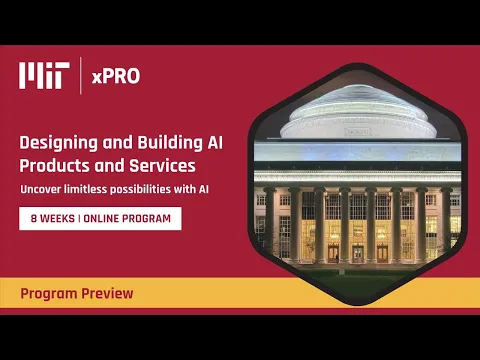
Course Preview | Designing and Building AI Products from MIT xPRO
9:49 min
4226
Ready to Learn More? Apply to Enroll in the Designing and Building AI Products Course with MIT xPRO
What Will You Learn in the Designing and Building AI Products and Services Program?
The MIT xPRO Designing and Building AI Products and Services program is a 10-week online program that builds the skills professionals and entrepreneurs need to take an AI-based product from concept to pitch. As a participant, you will work through core technology and business design principles that hold across domains and functions. The program concludes with developing an AI-based product proposal suitable for internal stakeholders or investors. Across the curriculum, you progress through each stage of AI product design while building a working grasp of machine learning, deep learning, and generative AI. Through live sessions and case studies with MIT faculty member Dr. Brian Subirana, the program also explores the emerging agentic AI landscape, including frameworks such as the Model Context Protocol (MCP).Build Technical and AI Product Design Capabilities
The program helps you:- Categorize different machine learning algorithms, including supervised, unsupervised, and reinforcement learning.
- Distinguish between CNNs, DNNs, and RNNs and understand their business applications.
- Understand transformer architectures and generative AI technologies.
- Evaluate the four stages of the AI design process.
- Enhance AI agents using RAG, chain-of-thought prompting, and tool integration.
- Analyze how humans and AI systems interact to improve decision-making.
- Understand how superminds combine human and machine intelligence.
- Predict AI opportunities across digital business processes.
- Build a business case for initiating an AI application, including strategic alignment, risk assessment, cost-benefit analysis, and implementation planning.
How Is the Designing and Building AI Products and Services Program Curriculum Structured?
The curriculum unfolds across 10 weeks, beginning with AI design fundamentals and progressing through machine learning, deep learning, generative AI, human-computer interaction, and applied AI product design. Every module combines technical concepts with product design skills through case studies and mini-lessons.Explore the AI Product Development Journey
Module 1: Introduction to the Artificial Intelligence Design Process Learn the stages involved in designing an AI-based product, including cost metrics and technical planning. Module 2: Artificial Intelligence Technology Fundamentals — Machine Learning Study Bayesian models, regression, supervised, unsupervised and semi-supervised learning, feature engineering, classifiers, logistic regression, support vector machines, clustering techniques, and model evaluation. Module 3: Artificial Intelligence Technology Fundamentals—Deep Learning Explore artificial neurons, neural networks, multilayer perceptrons, autoencoders, CNNs, RNNs, and real-world applications, including AI for breast cancer detection. Module 4: Designing Artificial Machines to Solve Problems Understand AI implementation, transformer architectures, generative AI capabilities, avatars, voice cloning, and limitations of AI through case studies. Module 5: Generative AI Learn prompt engineering, NLP embeddings, benchmarking, RAG, chain-of-thought prompting, and complete an interactive chatbot assignment. Module 6: Designing Intelligent Human–Computer Interaction Understand HCI techniques, application areas, trade-offs, and how to determine the right level of human involvement in AI systems. Module 7: Superminds Explore how humans and machines work together to solve organizational and community problems. Module 8: Marketplace Frontiers of AI Design Study generative adversarial networks, synthetic media, and the technical, social, and economic implications of AI. Module 9: Marketplace Frontiers of AI Design: Practice Apply the Lawler model to define an AI problem and build a summary of an AI product or process using concepts from throughout the program.What Do You Gain from the Program?
Apply Your Learning Through Practical Projects and Faculty Interaction
Throughout the program, you will have opportunities to apply your learning while engaging with MIT faculty through live online sessions. You will:- Develop an AI project proposal ready to present to internal stakeholders or investors.
- Earn an MIT xPRO certificate and six Continuing Education Units (CEUs).
- Build practical skills for evaluating AI opportunities and identifying appropriate technologies for your organization.
- Gain faculty insights into the evolving agentic AI landscape, Model Context Protocol (MCP), and customer service case studies.
- Deepen learning through crowdsourcing, demonstrations, and design-support activities.
- The Agentic AI Landscape — Present and Future: Examine industry developments, future priorities, and a practical scorecard for evaluating open- and closed-source AI approaches.
- Emerging Standards for Agentic AI: Understand the Model Context Protocol (MCP) and other emerging standards that support interoperable and autonomous AI agents.
- Case Study — Building an Agentic Platform from the Ground Up: Analyze a real-world customer service implementation, including business drivers, architecture, design patterns, and broader enterprise use cases.
FAQs About the MIT xPRO Designing and Building AI Products and Services Program
- What will I learn in the Designing and Building AI Products and Services program?
- Is this AI product development program suitable for professionals without a machine learning background?
- How is the MIT xPRO Designing and Building AI Products and Services program structured?
- Will I work on an AI product as part of the program?
- Who should enroll in the Designing and Building AI Products and Services program?
- What skills can I apply after completing the program?