
Lead Data Governance from the C-Suite With the Michigan Chief Data Officer Program

- Why Data Governance Belongs in Executive Conversations
- What Most Data Leaders Lack at the Executive Level
- How the Michigan Chief Data Officer Program Prepares Executives
- Real Outcomes of the Michigan Chief Data Officer Program: What Participants Walk Away With
- Elevate Data Governance and Leadership With Michigan
| Summary:
In the age of AI, data governance has become a strategic imperative. Discover how Michigan’s Chief Data Officer Program prepares senior leaders to lead with confidence and align governance with enterprise growth. |
Data governance has transcended its traditional role as a compliance function in the contemporary business landscape. It has emerged as a critical determinant of organizational success and resilience.
Escalating data breaches, exemplified by a 2024 IBM report1 indicating the average cost of a data breach at $4.88 million globally, underscore the financial imperative for robust data oversight and data security. Concurrently, the rapid adoption of AI technologies and intensified regulatory scrutiny, such as the EU’s AI Act, necessitate integrating data governance as a core component of enterprise strategy, not merely an operational task.
This blog highlights how Michigan’s Chief Data Officer Program enables senior executives to make data governance and AI a strategic priority by cultivating enterprise-wide vision, executive-level leadership skills, and influence across functions, especially when it includes data from various sources, requiring robust data integration and data pipelines.


Why Data Governance Belongs in Executive Conversations
Ensuring data quality and accessibility is paramount for any AI application. Gartner predicts that by 2026, organizations that successfully productize data will outperform competitors on most financial metrics by 20%.2 This is significantly supported by AI initiatives that leverage a strong data strategy.
Here’s why data governance and AI are immediately relevant in crucial areas:
- ESG disclosures: Accurate, verifiable, and well-governed data is indispensable for transparent environmental, social, and governance (ESG) reporting, significantly influencing investor confidence and corporate reputation.
- Customer data ethics: The ethical handling of customer data is no longer solely a compliance obligation; it represents a profound competitive differentiator that cultivates loyalty and mitigates costly reputational and legal missteps.
- AI explainability and bias mitigation: Without clearly defined data governance policies, the inherent opaqueness of AI algorithms can lead to biased outcomes, legal challenges, and a severe erosion of public trust. This is especially true for generative AI and other complex AI models, where transparency in training data is crucial.
With these stakes in mind, Michigan’s Chief Data Officer Program positions senior executives to take action, ensuring data governance is not an afterthought but a catalyst for enterprise success and driving innovation through AI-driven strategies.
What Most Data Leaders Lack at the Executive Level
Even highly proficient data leaders frequently encounter significant impediments when endeavoring to elevate data governance discussions to the executive level. Common challenges include:
- Difficulty influencing cross-functional leaders: Technical explanations often fail to resonate effectively with nontechnical business unit leaders who require a clear articulation of strategic impact rather than granular technical details.
- Technical language failing to resonate with boards: Presenting intricate data concepts using highly specialized jargon alienates board members primarily focusing on overarching business objectives, risk management, and shareholder value.
- Governance perceived as risk avoidance, not value creation: A prevalent executive perception views data governance primarily as a necessary overhead, a cost center focused on preventing problems rather than actively enabling growth, innovation, and competitive advantage.
How the Michigan Chief Data Officer Program Prepares Executives
The University of Michigan’s Chief Data Officer Program is meticulously structured to bridge this critical gap, equipping senior data leaders with the strategic foresight and executive presence required to lead effectively in the age of data and AI.
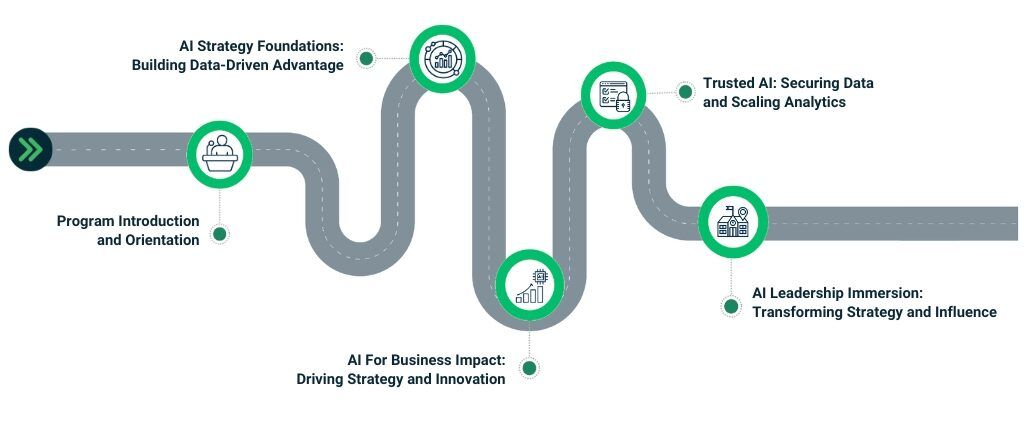
The Chief Data Officer Program builds your strategic leadership in data and AI through the following core modules:
- AI strategy foundations: building data-driven advantage: Establishes data strategy alignment with organizational goals and integrates governance frameworks for reliable data management and AI adoption.
- AI for business impact: driving strategy and innovation: Develops strategic road maps for integrating AI-driven innovation into product development and operations, linking data governance, AI, and analytics to business strategy.
- Trusted AI: securing data and scaling analytics: Focuses on navigating compliance laws (GDPR, CCPA, HIPAA), securing sensitive data through robust data security measures, building proactive risk management, and using analytics for strategic decision-making. This module emphasizes the integrity of data pipelines and the reliability of training data.
- AI leadership immersion: transforming strategy and influence: A five-day on-campus experience to elevate executive presence, decision-making, and influence, covering adaptation to future AI, strategic narrative development, and leading organizational change.
Beyond the structured curriculum, the program’s distinctive features further enhance the learning experience:
- World-class faculty: Learn from distinguished faculty from the Michigan Ross School of Business and the School of Information, experts in AI technologies and data strategy.
- Peer learning: Engage in invaluable peer learning with senior leaders from diverse industries.
- Business case simulations: Participate in simulations mimicking real-world scenarios.
- On-campus immersion: The final module offers an immersive experience with ecosystem exposure, networking, and site visits to leading tech organizations leveraging various AI systems.
Real Outcomes of the Michigan Chief Data Officer Program: What Participants Walk Away With
Participants of the Chief Data Officer Program emerge with a transformative skill set and an elevated strategic perspective, enabling them to:
- Reframe governance in board-level conversations: Confidently articulate the strategic imperatives of data governance, moving beyond mere compliance to highlight its pivotal role in driving innovation, securing competitive advantage, and ensuring responsible AI deployment.
- Adopt a strategic lens to align data policy with innovation and AI deployment: Develop the sophisticated ability to craft data policies that effectively mitigate risk and actively enable the ethical and efficient deployment of AI technologies and other cutting-edge technologies.
- Acquire tools to establish enterprise data councils, set governance KPIs, and lead change across silos: Gain practical frameworks and proven methodologies for constructing effective cross-functional data governance structures, defining measurable KPIs, and successfully leading organizational change initiatives.
- Attain enhanced credibility and readiness to step into or elevate in the chief data or AI officer role: Solidify your position as a visionary leader capable of navigating complex data landscapes and driving strategic initiatives at the highest echelons of the organization.
Elevate Data Governance and Leadership With Michigan
With the Michigan Chief Data Officer Program, senior data leaders gain the essential frameworks, articulate language, and critical influence to make that compelling case within the C-suite. So, elevate your leadership trajectory, transform your organization’s symbiotic relationship with data, and solidify data governance as an indispensable cornerstone of strategic growth with Michigan.
References