
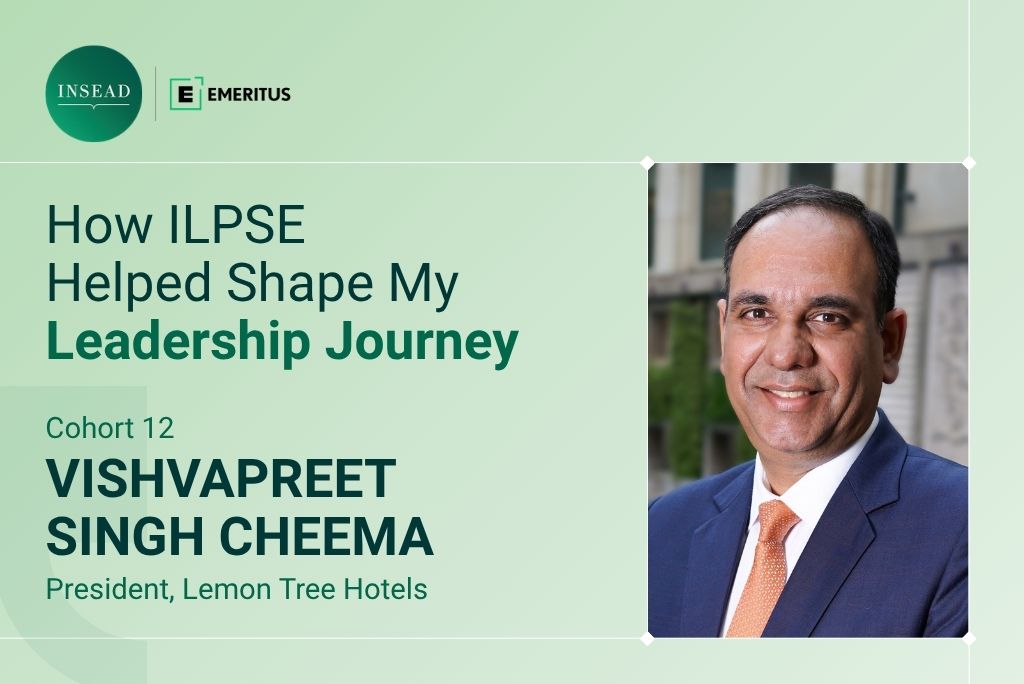
How INSEAD ILPSE Prepared Vishvapreet Singh Cheema to Lead as President of Lemon Tree Hotels
|
Synopsis: In this candid interview, Vishvapreet Singh Cheema, now leading Lemon Tree Hotels, reflects on INSEAD ILPSE that turned operational mastery into strategic leadership—and the promotion that followed within a year. |
Vishvapreet Singh Cheema spent three decades rising through five of hospitality’s best-known names—from management trainee at The Oberoi Hotels to President of Lemon Tree Hotels—building a reputation as an operator who could steer complex, multi-property businesses through brand mergers, cultural integrations, and a global pandemic. But operational excellence alone does not make a President, and Cheema knew it.
In 2023, at age 47 and several years into a senior regional role at IHG Hotels & Resorts, he enrolled in the INSEAD Leadership Programme for Senior Executives – India (ILPSE) to close that exact gap: the shift from operator to strategic leader. Within a year of completing it, he was named President of Lemon Tree Hotels. In a candid interview, Vishvapreet Singh Cheema reflected on what the ILPSE changed, why he chose INSEAD over three other leading business schools, how specific modules and faculty reshaped his thinking, and what it took to translate that learning into the C-suite. Here are the excerpts from the interview.

Q. Your career has taken you from The Oberoi Hotels to Lemon Tree Hotels. How did that journey lead you to ILPSE?
Each move built a different piece of my operational range, and by the time I applied to ILPSE, I could feel exactly what was missing. Inn-keeping at The Oberoi Hotels gave me discipline from the ground up, through one of the most rigorous training programmes I have ever experienced.
P&O Cruises put me alongside colleagues from more than 50 countries, an education in cross-cultural leadership no classroom could replicate. A single-hotel company, still securing its funding, taught me what it means to run a business with no financial safety net — you earn and burn yourself; if you cannot earn, you cannot burn.
Multi-unit roles at Marriott meant blending two distinct cultures across my properties after its Starwood acquisition.
And at IHG, as Director of Operations for South-West Asia, I was leading operations across four countries, including through COVID-19, one of the defining leadership tests of my career. By then, I had every operational tool I needed. What I didn’t have was a structured way to build the layer above it — strategic and visionary leadership — and that gap is precisely what sent me looking for a programme like ILPSE.
Q. What made you realize you needed a leadership programme like ILPSE instead of just more work experience?
I had genuinely excelled at operational leadership: executing strategy, managing crises, and hitting targets. But I came to see those same strengths as a ceiling.
I was a strong tactical leader, and the next step demanded that I be a strategic leader, one who develops a vision rather than simply executes one, shapes an organization’s culture, and enables stakeholders. More experience in the same role was only going to deepen the skills I already had.
I realized that I needed a structured programme that would deliberately build the ones I didn’t and that realization sent me actively evaluating executive leadership programmes, ILPSE among them.
Q. What made you choose INSEAD ILPSE among several leading executive programmes?
First, I work for a global company, and I wanted a genuinely global perspective: exposure to emerging markets while staying prepared to move into mature ones if the opportunity arose. INSEAD’s campuses across Singapore, the Middle East, and Europe made it a truly international institution, not one anchored to a single region. Harvard, by comparison, felt more America-oriented, and post-COVID visa constraints added further friction.
Second, the format had to work around a demanding job. ILPSE’s hybrid design—immersive modules blended with virtual learning—was the only structure that let me pursue transformational leadership without stepping away from the role I was already excelling in.
Q. How did the INSEAD Leadership Programme for Senior Executives (ILPSE)-India change the way you think as a leader?
Two modules reshaped my thinking most: change management and decision-making. Change management taught me to manage myself first, so I could draw out the best in the people around me, rather than continuing to micromanage the way I had as a Director of Operations.
The decision-making module, anchored in game theory, taught me to anticipate what another person, company, or institution is likely to do, and to stay a step ahead. I still apply that discipline today, including in how Lemon Tree Hotels approaches AI adoption inside an organization shaped by 25 years of legacy thinking—we have since built a dedicated internal unit for it, because hospitality has historically been slow to adopt new technology, and I was determined that we would not be.
The faculty made these ideas stick. Professor Guoli Chen’s teaching on Blue Ocean Strategy has stayed with me long after the module ended. And Professor Paddy Padmanabhan’s Phoenix Encounter Method, where participants build a business model and then have peers deliberately attack it, left enough of an impression that I have since gifted the book to colleagues, including my own boss’s boss.
Q. You were one of only two participants from hospitality in your cohort. How did that shape the experience?
What initially looked like a disadvantage turned into one of the most valuable parts of the programme. Sitting alongside leaders from technology, banking, healthcare, manufacturing, and consulting forced a different lens entirely. You discover that the underlying challenges are strikingly consistent across industries—a staffing shortfall in hospitality is not fundamentally different from one in technology, only the response differs. One classmate walked us through Amazon’s hiring process: thirteen layers of checks built specifically around culture fit. I have not replicated it exactly, but it permanently changed how I think about who we bring into our organisation.
Q. What was the hardest leadership habit you had to unlearn on the way to becoming President?
Letting go. As a Director of Operations, I was still micromanaging certain functions, holding on to decisions I should have delegated long before. That instinct does not disappear the moment your title changes, and for a long stretch of my career, I was genuinely unclear on the difference between a manager and a leader.
The INSEAD Global Executive Leadership Mirror, a structured 360-degree feedback and coaching process, made that gap impossible to ignore. I entered it wanting to be genuinely self-aware, to understand both my strengths and my opportunity areas, so the latter would not become a ceiling as I grew further.
What emerged clearly was that I needed to step back and allow others to lead, rather than continuing to hold on the way I always had. Companies do not want managers at senior levels — they want leaders: people who set direction, articulate a vision, and then trust their teams to reach it.
Q. How would you describe the shift ILPSE pushed you to make, in your own words?
Before ILPSE, I operated comfortably at 30 feet and 3,000 feet—the tactical and the operational. I was never at ease at 30,000 feet. Now I can move fluidly between all three. That range gives me the strategic confidence to hold a conversation at the board level, then return to execution without losing either thread. Within a year of completing the programme, I stepped into the President role at Lemon Tree Hotels. That is not a coincidence.
Q. What advice would you give professionals who are thinking about joining ILPSE?
Do not wait for the perfect moment. There will always be a reason to delay, whether cost or timing—people around me questioned whether it was the right time to invest in myself. But once your decisions are already shaping outcomes for a large team and a company, that is the moment to invest in transformational leadership, not some point further down the road.
Second, come in willing to understand yourself honestly. I watched people in my own cohort grow defensive about what the 360-degree process surfaced about them. The ones who leaned into that discomfort instead are the ones who walked away as better leaders.
While instincts carried him from front desk to regional director, the INSEAD Leadership Programme for Senior Executives – India (ILPSE) helped Vishvapreet Singh Cheema expand his leadership range—the ability to move between boardroom strategy and operational execution with confidence. After nearly three decades of operational experience, the programme gave him a structured opportunity to strengthen the strategic perspective he felt he needed for the next phase of his career.