
What Today’s Supply Chain Leaders Must Rethink and Why It Matters Now
- From Linear Thinking to Systems Thinking: Rethinking the Supply Chain
- Reverse Logistics: From Afterthought to Differentiator
- The Amazon Model: Balancing Responsiveness and Efficiency
- My Framework for Digital Supply Chain Transformation
- Why Industry 5.0 Resonates with Me
- Final Thought: Future-Proofing Your Leadership
|
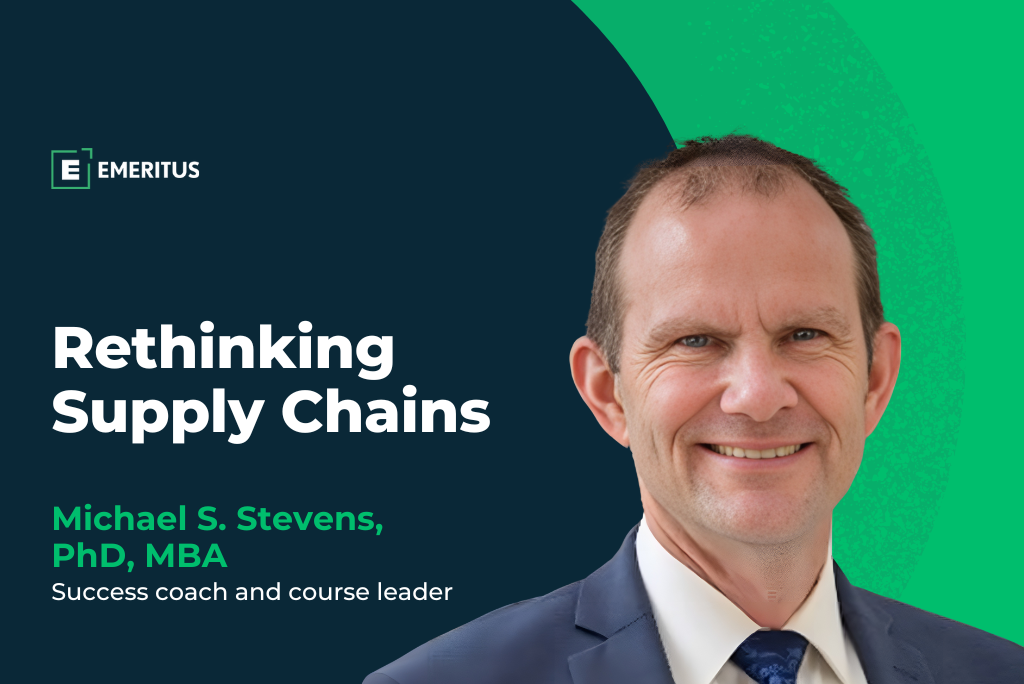
Synopsis: MIT xPRO Global Manufacturing and Supply Chain Leadership Program success coach and INSEAD Supply Chain and Strategy Program, MIT xPRO Supply Chain Management Program, and Wharton Global Supply Chain Management Program course leader Michael S. Stevens, PhD, MBA, explores frameworks that leaders can leverage to navigate the challenges of the supply chain landscape. |
When people ask me what has changed most about the supply chain in recent years, my first instinct is to say: everything. But the truth is more nuanced. The fundamentals of supply chain management have not disappeared—we still talk about sourcing, manufacturing, and logistics. What has shifted is how we think about the system itself.
After working across industry, coaching executives, and being a course leader in global supply chain leadership programs, including the:
- MIT xPRO Global Manufacturing and Supply Chain Leadership Program
- MIT xPRO Supply Chain Management Program
- Wharton Global Supply Chain Management Program
- INSEAD Supply Chain and Strategy Program
I have found that many challenges senior professionals face boil down to this: we are using yesterday’s models to solve today’s problems.
That is why I now focus on frameworks that help supply chain leaders—especially those navigating complex supply chain operations—reframe their thinking in the face of digital disruption, shifting customer expectations, and global volatility.
From Linear Thinking to Systems Thinking: Rethinking the Supply Chain
Most professionals begin with a traditional view of the supply chain as a linear process:
procurement → production → distribution
But that view is increasingly inadequate in today’s global supply chain environment. To lead effectively, we must shift from linear thinking to systems thinking.
I encourage participants to reframe the supply chain as a dynamic, interconnected platform—a living network that extends from the supplier’s supplier to the customer’s customer. It is not just about what moves downstream, but also about what flows back upstream. Logistics, data, customer service, and returns are all part of this evolving system.
This broader lens reveals how reverse logistics, in particular, has become a strategic imperative. In sectors like fashion and electronics, returns are no longer an exception — they shape supply chain design just as much as outbound distribution.


Reverse Logistics: From Afterthought to Differentiator
Years ago, reverse logistics was treated as a necessary evil — something to manage, not master. Today, it is a defining capability.
In the fashion industry, for instance, return rates of 30–40% are common. Companies that succeed here design for reverse flows with speed and scale in mind—supported by data, automation, and integrated service.
If your supply chain operations can’t handle reverse logistics with precision, you are losing efficiency and, in the process, are compromising the customer experience.
The Amazon Model: Balancing Responsiveness and Efficiency
One of the most actionable frameworks I teach in our supply chain leadership programs is what I refer to as the Amazon trade-off model. It offers a powerful lens for understanding how modern supply chains navigate the tension between responsiveness and efficiency.
Amazon has redefined customer expectations by prioritizing speed, flexibility, and convenience—often choosing responsiveness over pure cost minimization. This forces supply chain executives to make deliberate trade-offs that balance:
- Transportation cost vs. inventory holding cost
- On-demand fulfillment vs. batching for efficiency
- Centralized storage vs. distributed speed to customer
For senior executives evolving their supply chain strategy, this model illustrates how operational choices shape customer experience—and how supply chain management becomes a critical source of competitive advantage in the digital economy.


My Framework for Digital Supply Chain Transformation
Transformation is not just about installing new technology. It is about changing how we lead. In my courses, I suggest a four-part model for digital supply chain transformation:
Digitalization: Use data to anticipate needs, align teams, and act faster. Real-time analytics enable supply chain leaders to shift from reactive problem-solving to strategic foresight, breaking down silos and improving coordination across procurement, logistics, and customer service.
Service Integration: If you have a product, you should offer a service — and if you have a service, you should offer a product. Modern supply chains must support both, embedding customer-facing capabilities like personalization, reverse logistics, and post-purchase support directly into the delivery experience.
Business Model Shift: Move from process optimization to innovative augmentation. Leverage technology not just to streamline operations, but to augment the business model with customizable, tech-enabled offerings that drive both flexibility and growth.
Human-centric technology: Design systems that empower people across age groups, roles, and demographics—recognizing that inclusive, diverse teams are essential to building resilient and adaptive supply chains in an increasingly complex world.
This is a key part of the learning experience in any serious supply chain leadership program— understanding how digital tools shift value creation at every level.
Why Industry 5.0 Resonates with Me
Most companies are still coming to terms with Industry 4.0. However, we are already seeing the rise of Industry 5.0, a more human-centered paradigm, and I believe this concept will become much more popular in the coming years.
We see in the emerging concept:
- Collaboration between humans and intelligent machines
- Personalization through agile supply networks
- Sustainability and ethics baked into the core of the chain
For modern supply chain leaders, this represents a mindset shift—from automation alone to responsible innovation.


Final Thought: Future-Proofing Your Leadership
In every cohort I am associated with, I see professionals grappling with the same questions:
- Where do I start?
- Are we adapting our supply chain strategy fast enough?
- Can our teams make smart trade-offs in real time?
- Are we ready to lead through the next disruption?
- How do I manage the cost–benefit–risk management equation?
Programs that offer a fast track to strategic fluency—combining real-world frameworks with peer collaboration are critical for any senior executive in operations, logistics, or transformation.
As I often remind learners, supply chains are no longer about getting stuff from point A to point B. It is about enabling your business to adapt and thrive in real time.
If that is the kind of leadership you want to practice, it starts with how you choose to learn.
(Dr. Michael S. Stevens, PhD, MBA, is a success coach for the MIT xPRO Global Manufacturing and Supply Chain Leadership Program and course leader for the INSEAD Supply Chain and Strategy Program, MIT xPRO Supply Chain Management Program, and Wharton Global Supply Chain Management Program. All views expressed here are his own.)