
Course Preview | AI-Driven Health Care Transformation from Harvard Medical School
7:52 min
438
Welcome. My name is John Glasser, and I'm the director of this program that will bring together the material in the Harvard Medical School Program on Leading Digital Transformation Health care and the material in the Harvard Medical School Program on Artificial Intelligent Health Care. In this module, I will review the approach to bringing the material together, the program objectives, and the program modules. Now, let's start with the approach. Let's assume or imagine that you're a senior executive and you're in a board meeting in which the topic is AI. The board is reviewing the diverse power of the technology but is also concerned about the technology's limitations and its maturity. It looks at some of the ways that AI is being used, and it's quite striking. AI bots are being used to provide digital therapy for people suffering from depression and anxiety. AI and deep learning algorithms are being used to plow through electronic health record data and identify secondary uses of medications and places where medications might be actually causing harm. Deep learning is being used to scan the genetic code and determine the protein structure that will result. These are very complex structures and this use of AI may accelerate drug discovery to a material degree. Now, we've also noticed in a more pedestrian way, I guess, is that generative of AI can be used to provide basic diagnosis and treatment recommendations for things like flu or a sprained ankle, etcetera, it does a pretty good job.
Now, that being said, there's some concerns with AI. A study done by some folks looking at COVID algorithms or algorithms that were directed to predicting who would get COVID and then how sick they might get, found that of the 232 algorithms they looked at, none were fit for clinical use. Why? Because the data was not very good or the testing was sloppy. In addition, generative AI has been known to quote, hallucinate, make stuff up. One of my favorite examples is asking the generative of AI, what's the world record for walking across the English Channel? And it came up with an answer on this particular date, this particular individual walked across the channel. And it also reminds you that should you try to do that, this is particularly difficult, I guess so. Now, when the board looks at that and says strength, amazing in fact, but concerns pretty serious. But it also realizes how early we are in the use of AI. Now, in a lot of ways, AI has been around for a long time, since the mid 50s. But on the other hand, if you look at the explosive interest in deep learning and generative AI, you realize how early we are. In fact, those of you familiar with the Gartner Hype Cycle will note that most of the AI use is on the left. It's on the peak of inflated expectations. There's actually very little that is way on to the far right where there's a real understanding of the mature uses and the mature ways to retrieve value from AI.
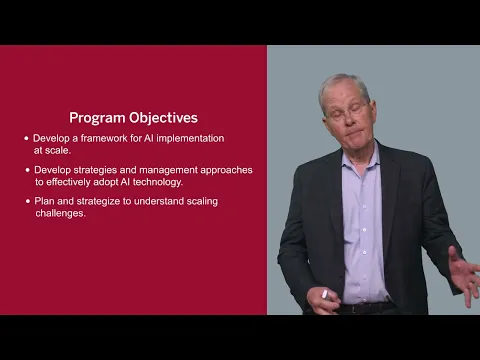
So, the board chair turns to you and says, look, AI has extraordinary potential and it's really likely to be an important contributor to our digital transformation initiative. However, there appears to be some significant peril with AI. We want to take advantage of the opportunities, but we don't want to be exposed to significant problems. So, what do you think we should do about AI in the next two to three years? How should we approach this class of digital technologies? What is our AI management plan? We look forward to hearing from you at the next board meeting. The assignment has landed on your lap, so this program will help you address these questions. The program has several objectives. First is enable you to develop a comprehensive framework for AI implementation at scale at an organization that you choose. The second is from that framework, be able to develop strategies and management approaches to adopting this technology effectively. The third in that plan and strategies is making sure that you understand the challenges that the organization is likely to face in scaling AI. And from all of that is to begin the process of developing tactical and strategic plans that are necessary for the transformation of the organization enabled by AI. Now, in the course of our time together, we'll cover 12 topics.
One is educating management so they're aware of the strengths, the capabilities, the limitations of AI. The second is organizational learning, and by that we mean that pilots are being conducted, the organization has a chance to put their hands on it, see it in a rough front and in real use. The third is the creation of a group that will help with the understanding and the learning about AI and then promote this innovation broadly across the organization. It's the day in and day out engine behind getting AI up and running. The next one is dealing with vendors. I'm sure as you know by now all vendors have, I've got AI this and AI that along with my cloud stuff, but how do you deal with that and how do you deal with those claims? We'll talk about AI limitations, some of which we've mentioned bias, hallucination, etcetera. And what do you do? We'll look at the AI context. In other words, is it really essential to our transformation strategy or just kind of an important, but not all that exciting, necessary contribution to some products and services that we might buy. We will continue to run this process to go through and make sure that we understand how to establish AI governance. In other words, the overall senior level leadership structure that make sure that the plans are headed in the right direction and delivering the right kind of insight. We'll talk about acquiring AI talent, we'll talk about managing the data that AI is driven by, and we'll talk about how you fit AI technology into the technology architecture of the organization.
We'll discuss some of the issues associated with implementing AI at scale. And then last but not least is participating in the industry. AI is new, so it's important that you engage with your colleagues in the industry at large to learn and to understand what's working and what's not. And it's important that you participate in the government process as government seeks to establish regulations surrounding this technology. Now, what you will have in these 12 modules is in effect a framework or an outline for the framework of the what the board has asked you to do. It is, in fact, a table of contents for the plan that you will develop. And one of the important things to remember here is while what you don't want to do is say to the board, let's do these 12 pilots or these 12 projects. You want to do that, but you also want to set in place the management progress, the management approaches. The management means by which AI will be looked at and adopted for years to come. This will take years to play out. This is not something that will be done in one year. So, in the course of each of these modules, you will have an assignment. We'll ask you to record your response to the assignment in the playbook.
Now, these assignments will enable you to progressively develop an AI adoption framework and plan for the organization that you choose. These modules will be complemented with discussion opportunities in which you will share your framework or your plan to date with other learners and comment on the plans that they share with you. What I'd like to do is give you your first assignment. You will, in the course of our time together, be developing a plan for a specific organization. Your assignment is to pick that organization and briefly describe its products, services and market. I'll see you in the next module.