
“Design is Who I Am Now”: Pratik Bhatnagar’s Pivot from Innovator to Government Changemaker and How IIT Delhi’s Design Thinking Programme Supported it!
- “I’ve Probably Been a Designer All Along”
- “MBA Teaches You the What—Design Thinking Teaches You the How”
- “India is a Design Powerhouse—We Just Don’t See Ourselves That Way”
- “This Course Was Designed for Joy, Not Just a Certificate”
- “Our WhatsApp Group Began in Chaos, But Became a Community”
- “Design Thinking Changed How I See Myself”
- “My Capstone Project Helped Me See Connections I’d Never Considered”
- “This Programme Gave Me Permission to Say ‘I Don’t Know’”
For Pratik Bhatnagar, learning has never been linear—it’s been a lifelong, curious pursuit led by instinct, opportunity, and a desire to view the world through ever-evolving lenses. With a professional journey that spans global health, governance, and environmental work, he recently added a transformative tool to his repertoire: design thinking.
After completing the Design Thinking and Innovation programme from IIT Delhi, delivered via the Emeritus platform, Pratik shares how the course shifted not just how he solves problems—but how he sees himself.
“I’ve Probably Been a Designer All Along”
Pratik describes himself as a “radically curious person” and someone who has always branched off into different directions to learn. His academic and professional roots may be in economics, business, partnerships, and governance, but creativity has long influenced his approach.
“I’ve always been interested in the arts and in connecting creativity with business objectives. Even in business development, operations or governance roles, I was known for driving innovation,” he says.
A chance encounter on a train ride to Davos with Tim Brown, the former CEO and current Chair of IDEO, marked a pivotal moment in his journey. “We started chatting, and I realized how deeply design could intersect with impact work. Later, I had the chance to collaborate with IDEO on immunization programmes while working for a global health NGO. That was my first real, practical exposure to design thinking.”
Still, he wanted to deepen that understanding. “An MBA will teach you frameworks and business models, but not how to bring your left and right brain together. I saw design thinking as that missing lens,” he reflects.



“MBA Teaches You the What—Design Thinking Teaches You the How”
While Pratik’s academic journey began with economics, international relations and then an MBA, he always felt something was missing. “In all my professional life, I was known for bringing creativity into my work. I’ve always been interested in connecting creative thinking with real-world problems.” A few years ago Pratik worked as Head of Innovation at Gavi, in charge of its innovation accelerator programme that identified creative health technology solutions for country health systems. At WWF, he brought innovative thinking to enhancing organizational impact in the area of climate, conservation and environment.
“India is a Design Powerhouse—We Just Don’t See Ourselves That Way”
 While Western design schools had long captured Pratik’s interest, he deliberately chose the IIT Delhi Design Thinking and Innovation programme.
“Having worked in the enviornmental and global health sectors, I didn’t want to learn about the impact of design in developing country contexts second-hand. I wanted a programme rooted in the Indian context,” he explains. “India has always practiced design thinking—through jugaad, grassroots innovation, and everyday ingenuity and problem-solving. We just don’t call it “design thinking”, but that’s what it is! We Indians literally grow up in a design thinking crucible.”
For Pratik, the programme offered a rare opportunity to engage with design thinking in a way that was grounded, culturally relevant, and deeply practical.
“This Course Was Designed for Joy, Not Just a Certificate”
One of Pratik’s key takeaways from the design thinking programme was the immersive, holistic experience. “I expected something dry and theoretical. Instead, each class began and ended with music. As a student of classical Khyaal myself, I couldn’t have found a better space for creativity, reflection, and joy.”
He emphasizes that this wasn’t just another online learning credential to flaunt on LinkedIn. “This course was truly designed to transform the learner. It was about embodiment, not just education.”
“Our WhatsApp Group Began in Chaos, But Became a Community”
Though he couldn’t attend the in-person immersion sessions, Pratik found deep connection and support through his cohort. “Initially, there was confusion and a flood of repetitive questions. But over time, it became a space of learning, sharing, and support. It added a human layer that’s rare in online programmes.”
The relationships formed were as important as the curriculum itself—underscoring the value of learning in community, especially in a course as introspective and creative as this one.
“Design Thinking Changed How I See Myself”
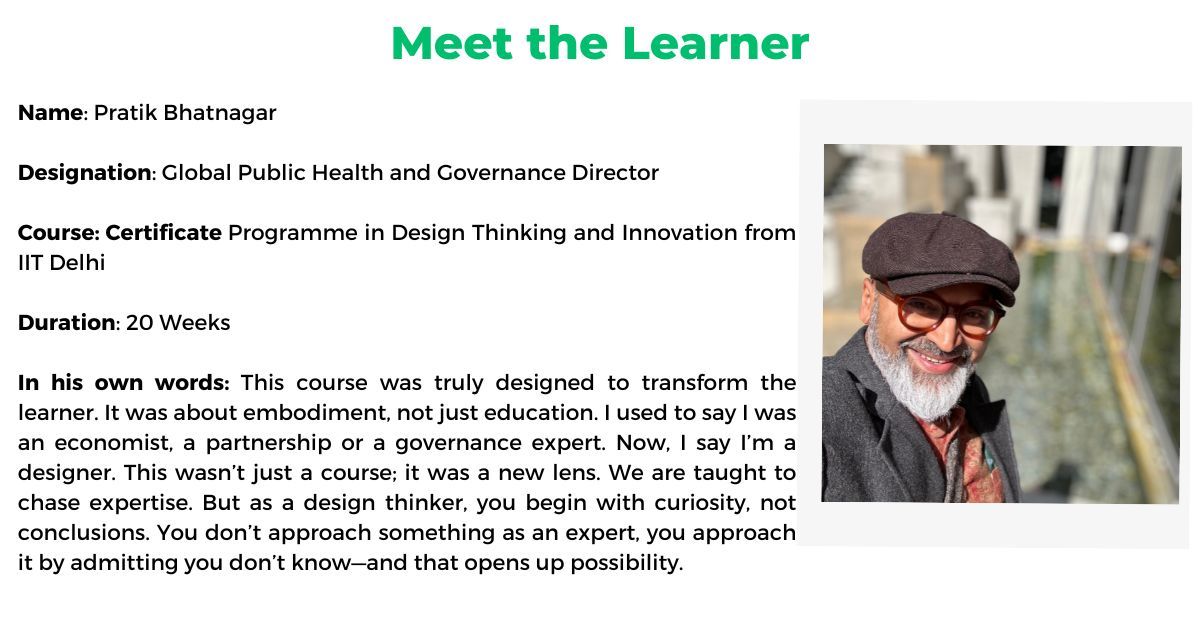
 Perhaps the most profound shift came in how Pratik saw his own professional identity. “I used to say I was an economist, a partnership or a governance expert. Now, I say I’m a designer. This wasn’t just a course; it was a new lens.”
That lens now guides how he views problems, creates solutions, and even makes life decisions. “Design is not just about making products—it’s a way of living, of thinking, of asking better questions.”
“My Capstone Project Helped Me See Connections I’d Never Considered”
Pratik’s capstone project explored cognitive decline and the future of learning in the context of AI—a subject far from his formal training. “I’m not a mental health expert or an AI professional. But design thinking gave me the confidence to explore it anyway. It’s about synaptic thinking—connecting dots across disciplines to create new pathways for insight and action.”
Pratik hopes to develop a body of work around this concept that he has trademarked in Switzerland, and sees his future as an entrepreneur grounded in various aspects and applications of design.
“This Programme Gave Me Permission to Say ‘I Don’t Know’”
What does Pratik think about the future of professional learning?
“We are taught to chase expertise. But as a design thinker, you begin with curiosity, not conclusions. You don’t approach something as an expert, you approach it by admitting you don’t know—and that opens up possibility. Not knowing is the start of the exploration of an appropriate solution with a “beginners mind”. Approaching something as an expert often means you start with a solution in mind. Being a designer is a completely different way of being.”
He believes the IIT Delhi Design Thinking and Innovation programme teaches learners to think in non-linear, reflective ways. “It’s not about memorizing frameworks. It’s about embodying a mindset. Once you start seeing the world this way, you can’t unsee it.”
 “We Need Design Thinking in Our Schools, Workplaces—and in Ourselves”
When asked why learn design thinking, Pratik’s response is clear: “Not because you want a promotion or a new job title. Learn it because you want to see more. Because you want to listen better. Because you want to be transformed.”
Pratik was recently sworn in as an elected member of the local government in Geneva and has the distinction of being the only Swiss citizen of Indian origin who is part of the governing process. “Design thinking principles are much needed to solve local issues, particularly in a cross-disciplinary and synaptic way. So while I sit on a few committees including finance, environment, land use and mobility, I hope to have ample scope to apply what I learned in IIT Delhi’s Design Thinking and Innovation programme.”
As he continues his journey—possibly as a design entrepreneur in the future—Pratik believes the real success of the programme lies in its ability to shape humans, not just professionals.