
From Creative Problem Solving to Human-Centred Innovation: Rashmi’s Journey With IIT Delhi’s Design Thinking and Innovation Programme
When Rashmi Goudar logged in for her first session of the Design Thinking and Innovation programme from IIT Delhi, she didn’t expect it to start with a short music rendition — let alone Hukus Bukus, a Kashmiri folk tune.
But there it was, flowing through her headphones, resetting the mood. And the next session? A different folk song or a short piece of classical music . The professor’s quirky ritual of starting every class with a new track wasn’t just entertaining — it helped learners drop their baggage from the day and refocus. “It was such a simple thing,” Rashmi says, “but it made you pause, become present. That set the tone for everything that followed.”
What followed, for her, was a journey of unlearning, discovery, and a deep shift in how she saw problems — both at work and beyond.
Reason d’arte: Solving a Real-World Challenge for the Education Sector With Design Thinking
When Rashmi Goudar signed up for the Design Thinking and Innovation programme from IIT Delhi, she wasn’t just looking to explore something new — she came in with a very specific challenge in mind.
During her tenure as a Programme Manager at an ed-tech organisation, Rashmi found herself working on a crucial question: how do you keep users engaged and motivated long after a project ends? She was focused on building sustainability into user behaviour — creating products that wouldn’t need constant nudging to stay relevant.
“Somehow, we couldn’t understand the decline in user motivation,” she recalls. “We had built something with a lot of intent and structure, but the engagement just dropped off. That’s when I knew we were missing something.”
That search for answers led her to the concept of design thinking. The idea of solving problems by deeply understanding the people affected by them—that struck a chord.
But she hesitated at first. “I assumed design thinking was just for designers or product managers in tech. I thought — I’m not building websites or apps, maybe this isn’t for me. I had heard of design thinking during my Teach for India fellowship days, but wasn’t sure how I could apply the principles in an edtech setting,” she admits.
Still, something nudged her forward. “I told myself — let me explore it. If things don’t work,, I’ll walk away having learned something new.”
Spoiler: She walked away with much more than that.


IIT Delhi’s Design Thinking Course Review: Biggest Takeaways
Unlearning Begins With Empathy
From the first few modules, Rashmi realised this wasn’t just another online certification. It was a reset button.
“The biggest shock? Realising how much we assume. How often we jump into solutions without really understanding the problem.”
Through case studies, peer collaboration, and structured frameworks, the programme urged learners to slow down, observe, ask better questions—and listen. Really listen.
“I always thought I was a good listener. But this taught me to dig deeper — to listen without prejudices and to find the why behind what users say,” she shares.
This mindset wasn’t easy to adopt at first. “It takes humility to say: I don’t know the answer. And even more humility to say: my first idea might not be the best one.”
Collaboration That Crossed Industries
One of Rashmi’s favourite parts of the experience was working with peers from completely different sectors. “There were architects, techies, UI/UX designers, educators, doctors, healthcare leaders, finance experts — and we were all trying to solve problems together with a human-centric design approach!
These diverse perspectives enriched every project. “Someone from architecture would approach the same challenge in a completely different way than someone from healthcare. That made it fun — and really eye-opening.”
Each assignment felt real. Rashmi brought her own work challenge into the classroom, using it as her lens for applying what she was learning. “That made everything click. It wasn’t theoretical anymore. It was immediately usable.”
A Shoutout to Professor VJ
At the heart of the programme, Rashmi says, was the incredible faculty — especially Professor VJ aka Vijayaraghavan Chariar.
“Professor VJ brought this energy that was contagious. He wasn’t just presenting slides. He was nudging us to think harder, deeper,” she says. “He created a space where we could be vulnerable, be wrong, experiment. That’s rare. Whether it was live sessions, feedback on projects, or even the thoughtful playlist that kicked off every class — his influence left a lasting impression.”
How the IITD DTI Programme Transformed Rashmi’s Mindset
Today, Rashmi still works in the education sector — but with a completely renewed approach.
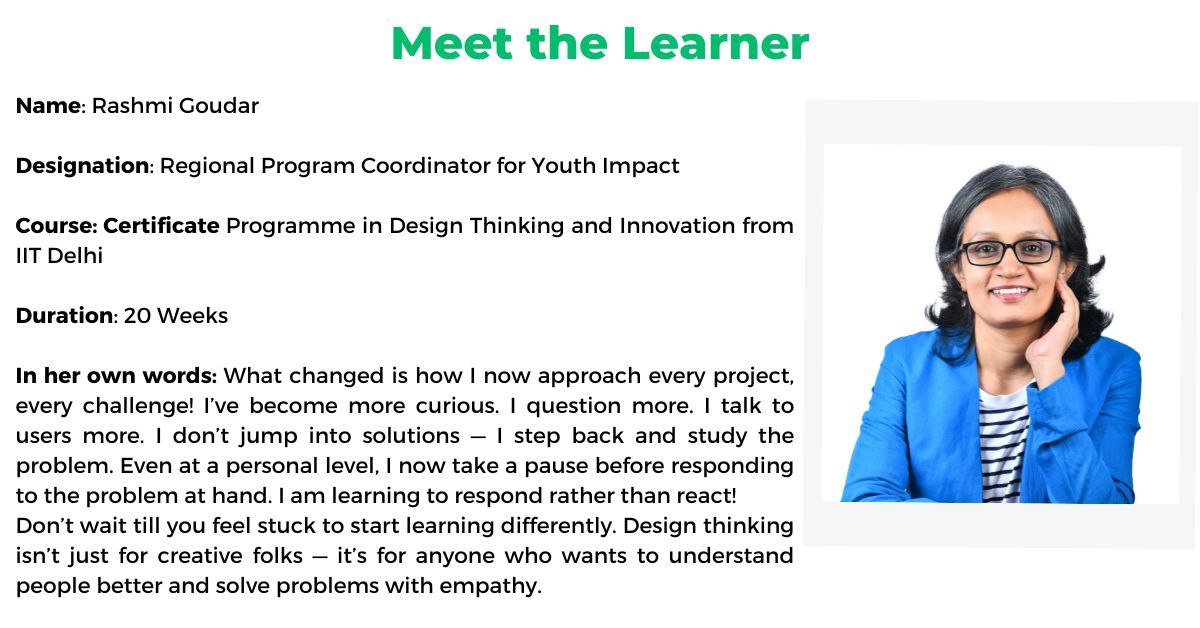
“What changed is how I now approach every project, every challenge!” she explains. “I’ve become more curious. I question more. I talk to users more. I don’t jump into solutions — I step back and study the problem. Even at a personal level, I now take a pause before responding to the problem at hand. I am learning to respond rather than react!”
That small shift in mindset has already improved how she approaches a problem, engages stakeholders, and evaluates success.
For Curious Minds Wondering, “Is This for Me?”
When asked what she would tell someone considering the Design Thinking and Innovation programme, Rashmi takes a thoughtful pause — and then speaks with conviction:
“Don’t wait till you feel stuck to start learning differently. And don’t count yourself out just because you’re not from a design background. Design thinking isn’t just for creative folks — it’s for anyone who wants to understand people better and solve problems with empathy.”
Her belief in its relevance is clear: “Bring a real challenge to the classroom. Something that’s live, messy, unsolved. The concepts will come alive in a way that’s deeply personal and immediately useful.”
Her parting note is simple, but profound:
“Come in with an open mind. Be ready to unlearn. That’s the best part — realising how much more there is to discover, even about the way you think.”
In fact, many of the top skills identified by the World Economic Forum’s Future of Jobs Report 2025 — such as analytical thinking, active learning, creativity, complex problem-solving, and resilience — are deeply embedded into the design thinking journey. At IIT Delhi, the capstone project becomes the crucible where these future-ready skills are not just learned, but applied in real-world scenarios.
If you’ve been looking for a way to approach your work — or your world — with fresh eyes, this could be your invitation to begin.